- +86 136 8127 5833
- [email protected]
- Shunyi, Beijing, China
Direct-from-factory clinical platforms certified for global distribution, engineered with advanced optoelectronic stability and OEM customization.
From photothermal damage to photomechanical disruption: How advanced pulse durations and selective photothermolysis redefine non-invasive dermatological therapy.
In contemporary aesthetic medicine, hyperpigmentation—encompassing melasma, solar lentigines, post-inflammatory hyperpigmentation (PIH), Nevus of Ota, and tattoo ink deposits—represents one of the most clinically challenging categories of dermatological disorders. The development of high-quality pigmentation removal equipment has undergone a paradigm shift, transitioning from primitive continuous-wave lasers to nanosecond Q-switched optical systems, and ultimately culminating in modern picosecond photo-acoustic technology.
The foundational biophysical principle governing non-invasive pigment destruction is Anderson and Parrish's theory of Selective Photothermolysis. To achieve target clearance without damaging surrounding cutaneous structures, the optical energy must be delivered at a wavelength preferentially absorbed by the target chromophore (melanin or tattoo pigment) within a duration shorter than or equal to the target's Stress Relaxation Time (SRT) and Thermal Relaxation Time (TRT).
Traditional Q-switched lasers operating in the 5–20 nanosecond pulse regime rely heavily on photothermal heating. While effective for localized dermal macules, the thermal diffusion into surrounding tissue increases the risk of epidermal injury, hyperpigmentation rebound, and prolonged post-treatment erythema, particularly in Fitzpatrick IV–VI skin tones.
High-end Picosecond equipment compresses pulse widths down to 300–750 picoseconds. By shortening the emission time beneath the acoustic relaxation threshold of melanosomes (approx. 1 nanosecond), the laser generates an intense photo-acoustic pressure wave. This stress fracture mechanism shatters melanin into ultra-fine dust-like particles, which are rapidly cleared via macrophage phagocytosis with minimal heat generation.
Choosing the correct laser medium is critical for optimizing depth of tissue penetration versus chromophore selectivity. Modern medical equipment manufacturing focuses on three key optical wavelengths:
A technical side-by-side evaluation for medical equipment buyers, clinical procurement managers, and distributor technical teams.
| Performance Parameter | Picosecond Laser Platform | Q-Switched Nd:YAG Laser | Narrow-Spectrum DPL / OPT |
|---|---|---|---|
| Primary Mechanism | Photo-Acoustic Shockwave (Pressure Wave) | Photothermal & Moderate Photomechanical | Selective Photothermal Coagulation |
| Pulse Duration | 300 ps – 750 ps | 5 ns – 20 ns | 1 ms – 20 ms (Pulsed Light) |
| Peak Power Output | Ultra-High (> 1.5 Gigawatts) | Moderate to High (50–200 MW) | Broadband Flashlamp Pulse |
| Particle Fragmentation Size | Micro-Fine "Dust" Particle Size | Coarse Granular Remnants | Thermal Denaturation of Melanosomes |
| Average Treatment Sessions | 2 – 4 Sessions | 6 – 10 Sessions | 4 – 8 Sessions |
| Risk of PIH (Darker Skin) | Ultra-Low (< 3%) | Moderate (12% – 25%) | High if fluences are uncalibrated |
| Target Indications | Melasma, Tattoos, Recalcitrant PIH, Ota | Epidermal Macules, Carbon Peels, Tattoos | Diffused Erythema, Freckles, Solar Damage |
Analyzing global commercial expansion, clinical consumption habits, and regulatory requirements shaping medical laser procurement worldwide.
Strict demand for CE Medical (MDR 2017/745) and FDA 510(k) compliant equipment. Buyers prioritize long-term optical cavity stability, low total cost of ownership (TCO), multi-wavelength versatility in a single chassis, and comprehensive clinical validation documentation.
High market prevalence of Fitzpatrick Types IV–VI skin combined with intense ambient UV exposure drives demand for non-thermal, low-fluence picosecond platforms. Clinics demand heavy-duty, dual-chilling cooling systems capable of continuous 12-hour operational stability in hot climates.
Surging demand for skin-brightening, melasma management, and tattoo removal treatments. Medical aesthetic clinic chains require OEM/ODM customization options, localized UI software translations, modular sub-assemblies for fast field maintenance, and high ROI turnaround.
When procurement officers evaluate high-quality pigmentation removal equipment suppliers, technical auditing extends far beyond external chassis design. High-tier distributors inspect four fundamental hardware metrics:
1. Beam Profile Uniformity (Flat-Top Beam Architecture): Traditional lasers produce a Gaussian energy distribution with a intense central peak that risks burning epidermal tissue while leaving spot edges under-treated. Enterprise-grade platforms utilize optical diffusers and micro-lens arrays (MLA) to shape energy into a uniform, homogeneous Flat-Top (Top-Hat) profile, ensuring consistent energy delivery across every square millimeter.
2. Optical Cavity Construction & Rod Quality: The longevity of a laser system relies on its internal optical generator. Utilizing imported Nd:YAG crystal rods (such as US-sourced Coherent components) combined with gold-plated reflective cavities prevents thermal degradation and maintains energy output accuracy over tens of millions of shots.
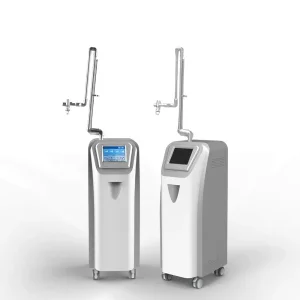
3. Articulated Arm Engineering: For high-power picosecond systems, internal handpiece fibers cannot sustain gigawatt peak power without dielectric breakdown. High-end equipment utilizes imported Korean 7-Joint Articulated Arms with counter-weight balancing, delivering zero power attenuation and 360-degree ergonomic flexibility for the practitioner.
Combining world-class optical component sourcing, precision automated assembly, and stringent QA testing to deliver superior OEM/ODM medical laser equipment.
SANO Laser builds platforms around standardized, modular industrial frameworks. Internal power units, water cooling channels, and optical circuitry are isolated in distinct shielded compartments, minimizing electromagnetic interference and allowing plug-and-play field replacement of parts within 15 minutes.
Our manufacturing facility integrates top-tier international optical elements: German laser diode stacks, US Coherent cavities, Japanese high-pressure water pumps, and Korean articulated arms. This hybrid supply chain pairs western optical precision with Chinese cost efficiency and rapid manufacturing scaling.
Every pigmentation removal machine manufactured in SANO's Beijing plant undergoes a rigorous 72-hour stress-testing protocol. Systems are subjected to over 100,000 continuous laser shots, extreme thermal cycling (-10°C to 50°C), energy density calibration verification, and electrical safety testing prior to container sealing.
Beijing Sano Laser Development S&T Co., Ltd. operates a specialized manufacturing hub in Shunyi District, Beijing. Unifying internal optoelectronic R&D, a dedicated clinical application testing room, custom casing engineering, and international customer support desks under one roof, SANO eliminates intermediary trading markups while offering robust OEM/ODM services.
Standard operating protocols for maximizing lesion clearance rates while mitigating post-treatment side effects.
Recommended Modality: 532nm Picosecond or DPL Narrow-Spectrum Light.
Clinical Protocol: Utilize a small spot size (2–4mm) with fluences calibrated to induce slight immediate micro-crusting or clinical whitening. Most superficial lesions resolve completely in 1 to 2 sessions without scarring.
Recommended Modality: Low-Fluence 1064nm Picosecond Laser Toning.
Clinical Protocol: Melasma treatment requires avoiding excessive thermal stimulation which can activate melanocytes. Utilizing large spot sizes (7–10mm) at low fluences (0.8–1.5 J/cm²) shatters melanosomes without disrupting the basement membrane, suppressing pigment rebound.
Recommended Modality: Dual-Wavelength (1064nm / 532nm) or 755nm Picosecond Laser.
Clinical Protocol: Black/blue inks are targeted at 1064nm, red/purple inks at 532nm, and green/cyan inks at 755nm. Ultra-short photo-acoustic pulses shatter ink matrices into cellular debris, reducing total required treatment sessions by up to 50% compared to legacy Q-switched units.
Factory-direct wholesale equipment solutions engineered for clinic expansion, high patient volume, and long service life.
In-depth answers from our engineering desk regarding equipment compliance, clinical efficacy, maintenance, and international OEM sourcing.
The core distinction lies in pulse duration. Q-Switched lasers operate in the nanosecond range (5–20ns), relying heavily on photothermal energy that heats melanosomes to fracture them. Picosecond lasers shorten the pulse to under 1 nanosecond (300–750ps), generating a pure photo-acoustic pressure wave. This photo-acoustic shockwave shatters pigment into much smaller particles ("dust" vs "pebbles") with virtually zero heat dispersion, drastically reducing treatment sessions and lowering the risk of post-inflammatory hyperpigmentation (PIH).
SANO Laser utilizes dual-cycle micro-channel liquid cooling combined with high-capacity Japanese water pumps and custom TEC thermoelectric refrigeration modules. Water temperature is actively maintained between 20°C and 25°C. Additionally, our laser cavities feature gold-coated optical reflectors and US-imported Coherent crystal rods that maintain linear optical efficiency during extended 10+ hour continuous operation.
The 1064nm wavelength is the safest standard for darker phototypes. Because melanin absorption decreases at 1064nm compared to 532nm or 755nm, the laser penetrates past the pigmented epidermis down to the dermis without causing epidermal burns. When combined with low-fluence picosecond pulse widths, 1064nm delivers safe melanosome clearance without triggering hyperpigmentation rebound.
We offer end-to-end custom engineering for enterprise distributors: chassis industrial design, custom exterior paint matching, brand logo integration, multilingual software UI development, software parameter pre-sets, and custom packaging. Furthermore, we provide full technical documentation dossiers (including CE testing reports, ISO 13485 quality standards, and safety certification files) to assist local registration in destination markets.
All SANO medical platforms include a 2-year comprehensive factory warranty backed by engineer-led 24/7 technical support desks. Because our machines are constructed using modular sub-assemblies, replacement modules and spare consumables are dispatched worldwide via express air delivery within 48 hours of ticket diagnostic confirmation.