- +86 136 8127 5833
- [email protected]
- Shunyi, Beijing, China
Direct OEM/ODM enterprise solutions manufactured with rigorous CE safety compliance and precision engineering.
Why sub-nanosecond pulse widths redefine chromophore fragmentation and aesthetic return on investment.
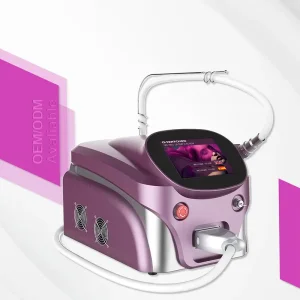
In the rapidly evolving global market for medical aesthetics, the transition from traditional Q-Switched nanosecond lasers to picosecond laser systems represents a monumental paradigm shift. For medical directors, commercial aesthetic chains, and equipment distributors, evaluating the picosecond laser tattoo removal cost requires a sophisticated understanding of both photo-acoustic physics and long-term Capital Expenditure (CapEx) metrics.
Unlike nanosecond lasers that rely predominantly on photothermal effects—heating pigment particles until they undergo thermal expansion—picosecond lasers deliver energy pulses in ultra-short durations (typically between 300 to 750 picoseconds). This ultra-short pulse duration induces a strong photomechanical shockwave (Laser-Induced Optical Breakdown - LIOB). The rapid pressure acoustic wave shatters tattoo ink and endogenous melanin into microscopic, dust-like particles that are rapidly cleared by the body's lymphatic system.
Delivers pulse peak power exceeding gigawatts per square centimeter. This breaks stubborn ink pigments (including blue, green, and multi-session residual ink) into fine dust without causing collateral thermal necrosis in surrounding dermal tissue.
Reduces average total tattoo clearance protocols from 10–12 sessions down to just 4–6 treatments. Faster clearance translates directly into higher clinical throughput, increased client retention, and superior online clinic ratings.
Comparative analysis of capital investment, operational expenses, and clinical revenue generation across global regions.
The total cost environment for picosecond laser tattoo removal is bifurcated into two primary dimensions: Equipment Acquisition & Maintenance Cost (B2B Manufacturer Level) and Per-Session Patient Treatment Pricing (B2C Clinic Level). Understanding this relationship is critical for procurement managers seeking maximum return on investment.
| Regional Market | Avg. Machine Acquisition (USD) | Per-Session Patient Cost | Target ROI Horizon | CE Certification Priority |
|---|---|---|---|---|
| North America (US/Canada) | $120,000 – $250,000 (US Tier 1) / $25,000 - $45,000 (China OEM) | $200 – $600 / session | 8 – 14 Months | FDA 510(k) / CE Co-Compliance |
| European Union | €80,000 – €180,000 (EU Tier 1) / €18,000 - €35,000 (China OEM) | €150 – €450 / session | 6 – 12 Months | Mandatory Medical CE (MDR 2017/745) |
| Asia-Pacific & LATAM | $15,000 – $35,000 (Direct Factory Import) | $80 – $250 / session | 4 – 9 Months | CE Mark / ISO 13485 |
| Middle East & Africa | $18,000 – $40,000 (High-Power OEM Platforms) | $120 – $350 / session | 5 – 10 Months | CE Certification / Local MOH |
How advanced optoelectronic industrial clusters in China deliver premium CE-certified platforms at 35%-50% lower total cost of ownership.
Chinese laser hubs (such as Beijing and Guangdong industrial zones) integrate optical rod growth, chassis sheet-metal engineering, power board assembly, and software programming within localized 50km radiuses, drastically reducing manufacturing overhead.
Modern Chinese tier-1 factories operate under strict ISO 13485 quality management systems. Equipment undergoes 72-hour continuous energy burn-in testing, electrical safety validation (EN 60601-1), and electromagnetic compatibility checks (EN 60601-1-2) before export clearance.
Global distributors benefit from tailored shell aesthetics, multi-language UI software integration, proprietary treatment algorithm presets, and private labeling—enabling brand differentiation without inflated development budgets.
Partner directly with Beijing SANO Laser's certified R&D team. Benefit from factory-direct pricing, 2-year warranty support, and complete CE documentation for seamless regional import registration.
Targeting chromophore spectrums across diverse skin phototypes and pigment depth profiles.
Commercial clinical success relies on applying the correct wavelength to specific target chromophores. Professional CE-certified picosecond laser platforms integrate multi-wavelength capabilities (typically 1064nm, 532nm, 755nm, and optional 585nm/650nm handpieces) to cover the complete diagnostic spectrum.
Clinical Focus: Dark black, blue, and brown tattoo ink; deep dermal pigmented lesions (Nevus of Ota, Ito's Nevus).
Safety Profile: Low epidermal melanin absorption makes 1064nm the safest choice for Fitzpatrick Skin Types IV, V, and VI, eliminating post-inflammatory hyperpigmentation (PIH).
Clinical Focus: Red, orange, purple, and yellow tattoo inks; epidermal lesions (Solar Lentigines, Freckles, Cafe-au-lait spots).
Mechanics: High melanin and hemoglobin absorption. Requires precise fluence control to prevent micro-vascular purpura.
Clinical Focus: Resistant green and sky-blue tattoo inks; Pico-Toning & non-ablative skin rejuvenation via LIOB micro-lesions.
LIOB Effect: Generates localized vacuoles in the dermis, stimulating collagen synthesis and elastin remodeling with zero skin surface downtime.
Key technological innovations defining the next decade of medical laser manufacturing.
Transitioning from traditional Gaussian beam profiles to uniform Flat-Top beam distributions. The inclusion of Fractional Honeycomb diffusers enables concentrated energy micro-dots, inducing sub-dermal cavitation without fracturing the stratum corneum.
Modern CE-certified systems feature embedded real-time energy sensors inside the handpiece. Software automatically measures optical degradation, auto-calibrating power output on every startup to ensure absolute energy fluency and consistent clinical results over years of continuous operation.
A structured financial model evaluating payback timelines for clinic operators and distributors.
When investing in a medical-grade picosecond platform, purchasers must analyze total financial yield based on local clinical booking fees and operational overhead. Below is a real-world financial projection model based on a mid-sized aesthetic clinic acquiring a high-tier CE-certified Chinese OEM Picosecond Laser system.
| Financial Parameter | Conservative Estimate | Moderate Estimate | High-Volume Clinic |
|---|---|---|---|
| Initial System Investment (CapEx) | $22,000 (China Factory Price + Freight) | $25,000 (Incl. Custom Shell & Specs) | $35,000 (Dual Handpiece & Air Chiller) |
| Patients / Day (Tattoo & Toning) | 2 Patients / Day | 5 Patients / Day | 10+ Patients / Day |
| Average Session Fee | $180 / Session | $220 / Session | $250 / Session |
| Monthly Gross Revenue (22 Days) | $7,920 / Month | $24,200 / Month | $55,000 / Month |
| Est. Payback / Break-Even Horizon | 3.5 Months | 1.2 Months | < 1 Month |
In-depth answers curated by our senior optoelectronic R&D engineering team.
Expand your clinic's service matrix with high-performance cooling, HIFU, RF microneedling, and diode laser platforms.