- +86 136 8127 5833
- [email protected]
- Shunyi, Beijing, China
The international medical aesthetic market has witnessed an unprecedented surge in demand for non-invasive laser pigment clearance systems. As tattoo prevalence reaches over 30% among adults in Western nations, the commercial demand for high-efficiency, multi-wavelength tattoo removal platforms has expanded rapidly. However, purchasing managers, clinic owners, and medical device distributors face a highly opaque pricing ecosystem. Factory-direct EXW rates for advanced Q-switched Nd:YAG and Picosecond laser platforms vary from $2,500 to upwards of $45,000, while Western brand distributor prices often range between $80,000 and $160,000 for comparable optical architecture.
Understanding the core cost drivers behind OEM tattoo removal machine prices requires dissecting hardware specifications, optic pump configurations, pulse width durations, power supply topologies, and regulatory compliance engineering. This industrial report serves as a comprehensive B2B sourcing guide to evaluate global manufacturer pricing, China OEM efficiency advantages, hardware technical matrices, and Total Cost of Ownership (TCO) benchmarks.
When evaluating OEM tattoo removal machine prices across global manufacturers and factories, B2B procurement officers must look beyond casing design and shell aesthetics. The true capital cost of a laser platform is governed by its internal optoelectronic components, thermal management systems, and laser cavity engineering.
Single-rod vs. Dual-rod Nd:YAG architecture heavily dictates power output and price. High-end OEM factories utilize dual purple YAG laser rods powered by double xenon flash lamps. Dual-rod configurations double peak energy output (reaching up to 2000mJ in nanosecond units and over 1.5GW peak power in picosecond models), ensuring complete ink fragmentation without overheating skin tissue. Dual-rod assemblies increase raw manufacturing cost by 35% to 50% over single-rod entry-level units.
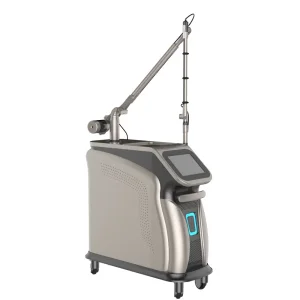
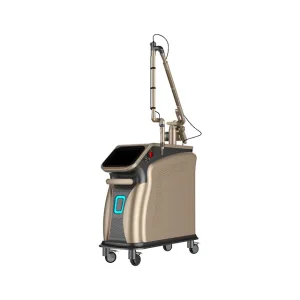
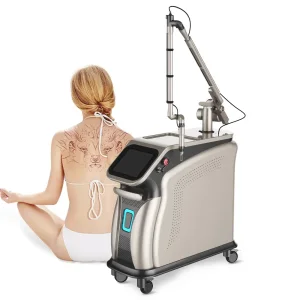
True picosecond lasers require precision optical transmission. Premium manufacturers integrate imported 7-Joint Articulated Arms (typically sourced from specialized Korean optical optics producers) with 360-degree rotation and counter-weight balances. These precision arms prevent energy degradation along the optical path and cost between $1,200 and $3,500 per unit, compared to inexpensive $150 fiber-optic cables found on budget portable devices.
Achieving photo-acoustic ink shattering requires ultra-short pulse widths (200ps – 600ps). Standard Q-switched lasers operate in the nanosecond range (5ns – 10ns), which relies heavily on photothermal heating, increasing scarring risks. True ultra-short pulse capability demands high-frequency capacitors, OPT power modules rating 2000W to 3000W, and custom seed laser diodes, representing a major factory cost factor.
The table below provides realistic OEM factory pricing expectations (FOB China / Direct Manufacturer) versus Western Brand Retail Distribution pricing for various tattoo removal machine categories.
| Machine Modality & Tier | Core Optical Specifications | OEM Factory FOB Price Range | Western Retail Price Range | Target Clinical Applications |
|---|---|---|---|---|
| Entry Portable Q-Switched Nd:YAG | Single Rod, 1064/532nm, 5-10ns, 500-1000mJ, Handpiece Delivery | $1,800 – $3,200 | $12,000 – $22,000 | Basic black ink tattoos, eyebrow removal, carbon peels |
| Clinical Vertical Q-Switched Nd:YAG | Dual Rod, 1064/532/1320nm, 6ns, 1600mJ, High Power Water Cooling | $3,500 – $6,500 | $25,000 – $45,000 | Full spectrum dark/red ink removal, epidermal pigment, facial rejuvenation |
| Commercial Pico-Second Laser System | Single/Dual Rod, 1064/532/755nm, 450ps-800ps, Articulated Arm | $6,800 – $12,500 | $45,000 – $85,000 | Multi-colored recalcitrant tattoos, Melasma, Nevus of Ota, skin texture |
| Medical-Grade Active Q-Switch / Ultra-Pico | Dual Purple Rods, <350ps, 2000W OPT Power Supply, Auto-Spot Detection | $14,000 – $24,500 | $90,000 – $160,000+ | High-volume medical dermatology chains, surgical centers, complex inks |
China’s medical aesthetic manufacturing industrial clusters—primarily located in Beijing, Guangdong, and Jiangsu—have transformed the economics of energy-based device (EBD) production. Over the past decade, Chinese OEM/ODM factories have evolved from simple contract assemblers into integrated R&D powerhouses offering full technical compliance, modular customization, and unparalleled cost performance.
Proximity to domestic optical crystal fabricators, precision laser power supply manufacturers, and injection molding specialists allows Chinese factories to reduce component procurement lead times from months to days. This localized supply ecosystem dramatically drops bill-of-materials (BOM) overhead.
Leading OEM manufacturers maintain internal optical laboratories and clinical testing suites. Foreign distributors can request customized shell industrial design, proprietary software UI GUI layouts, and tailored wavelength handpiece add-ons with initial prototype delivery within 30 to 45 days.
Top-tier factories operate cleanroom assembly lines under ISO 13485 quality management systems. Systems are engineered with CE medical certifications, RoHS testing, and full technical documentation files (TCF) designed to assist global importers with local medical device clearances.
Selecting the appropriate tattoo removal equipment requires matching system capabilities and price points to specific clinical operating environments. Buying an overly complex $20,000 picosecond system for a small studio doing basic cosmetic eyebrow touch-ups creates unnecessary capital strain, whereas buying an underpowered $2,000 portable laser for a busy dermatology clinic leads to device failure and burnouts.
Primary Goal: Partial fading to facilitate artistic cover-up work.
Recommended Unit: Portable or Vertical Q-Switched Nd:YAG (1064nm/532nm).
Budget Target: $2,500 – $4,500.
Operational Impact: Provides studio artists with control over skin preparation, generating secondary revenue prior to tattooing. Typical payback period is achieved within 3 to 6 months.
Primary Goal: Full ink removal, skin rejuvenation, carbon skin peeling, epidermal spot removal.
Recommended Unit: Dual-Rod Commercial Picosecond System with 755nm Honeycomb Lens.
Budget Target: $7,000 – $13,000.
Operational Impact: Broadens treatment menus. Shortened pulse durations reduce required patient sessions from 10+ down to 4-6, boosting client satisfaction and word-of-mouth referrals.
Primary Goal: Complex multi-color ink clearance, pigmented lesions, Ota nevus, scar revision.
Recommended Unit: High-Power Active Q-Switch / Dual Purple Rod Ultra-Picosecond Platform.
Budget Target: $15,000 – $25,000.
Operational Impact: Operates continuously in heavy-duty multi-operator environments. Ensures minimal thermal damage and maximum clinical safety for all skin phototypes (Fitzpatrick I-VI).
Experienced medical device purchasers know that the initial invoice price (CAPEX) represents only a fraction of the lifetime investment cost. Evaluating OEM tattoo removal machine prices requires analyzing Operational Expenditures (OPEX), maintenance cycles, consumable flash lamp replacements, and technical support SLAs.
Xenon lamps are the primary consumable in laser cavities. Standard lamps deliver 500,000 to 1,000,000 shots before pulse energy degrades. High-grade imported UK Xenon lamps integrated by top factories achieve up to 3,000,000 to 5,000,000 shots, dropping the ongoing cost-per-shot to fractions of a cent.
Laser diodes and flash lamps generate intense thermal loads. Budget devices with inadequate water pumps and small radiators shut down after 20 minutes of continuous use due to overheating. Industrial platforms incorporate Japanese DC water pumps, TEC semiconductor cooling plates, and stainless-steel water tanks for 12-hour non-stop operation.
Modern aesthetic platforms leverage Android-based or embedded Linux touch interfaces. Advanced OEM factories provide customized operator software featuring automated patient parameter databases, shot tracking, error logging, and optional Wi-Fi telemetry for remote factory diagnostic support.
As the tattoo removal industry matures, OEM manufacturers are continuously innovating to increase pigment clearance efficiency while reducing thermal side effects such as blistering and hypopigmentation. Buyers looking to future-proof their supply chain should align with manufacturers incorporating the following advancements:
While standard lasers rely on 1064nm (black/blue ink) and 532nm (red/orange ink), advanced platforms integrate additional wavelengths including 755nm Alexandrite (green/blue ink efficiency) and dye-impregnated handpieces producing 585nm (sky blue) and 650nm (bright green) wavelengths. OEM factories offering modular multi-wavelength configurations enable clinics to treat full-color custom sleeves safely.
The technological race in picosecond laser manufacturing centers on shrinking pulse duration. Shorter pulse widths increase photomechanical shockwave intensity while diminishing photothermal thermal diffusion time. Cutting-edge factories are transitioning from first-generation 750ps systems to sub-300ps architectures, delivering faster ink clearing with minimal tissue recovery downtime.
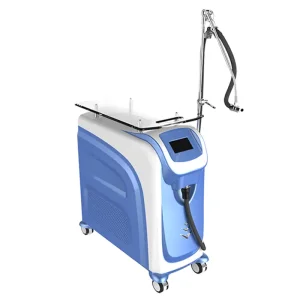
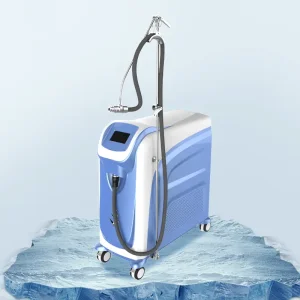
High-energy laser bombardment causes sudden epidermal heating. Leading OEM suppliers are bundling dedicated -35°C continuous cold-air chilling units directly with tattoo removal platforms. Synchronizing laser emission with sub-zero forced air cooling protects the stratum corneum, reduces operator risk, and dramatically improves patient treatment comfort.