- +86 136 8127 5833
- [email protected]
- Shunyi, Beijing, China
Precision-engineered platforms manufactured under ISO13485 standards for clinical excellence.
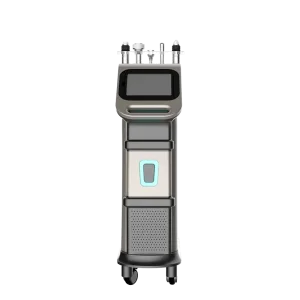
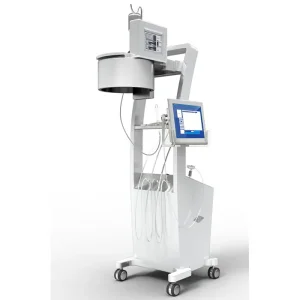
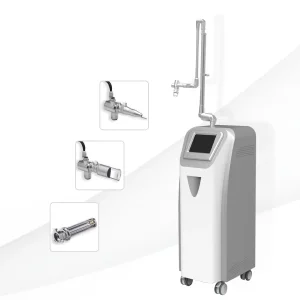
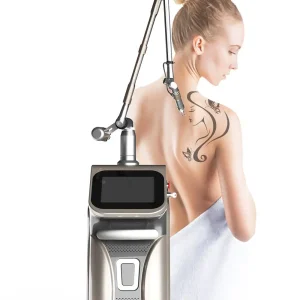
Understanding Selective Photothermolysis versus Photoacoustic Acoustic Disruption in Medical-Grade Pigmentary & Tattoo Removal Systems.
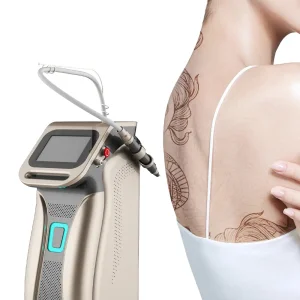
In the rapidly evolving landscape of aesthetic medicine and clinical dermatology, the Q-Switched Neodymium-doped Yttrium Aluminum Garnet (Q-Switch Nd:YAG) laser machine stands as the gold-standard therapeutic modality for target-specific pigment reduction, dermal lesion clearance, and complex tattoo removal. As a premier original equipment manufacturer (OEM) and direct factory in China, Beijing SANO Laser integrates high-level optical engineering, precision pulse duration tuning, and superior beam quality to provide worldwide distributors and clinical chains with unmatched therapeutic consistency.
When high-intensity 1064nm or 532nm laser radiation hits chromophores such as exogenous tattoo ink or endogenous melanosomes within nanoseconds, the temperature inside the pigment granule rises rapidly by hundreds of degrees Celsius. Because the pulse duration is shorter than the thermal relaxation time (TRT) of microscopic melanosomes (approx. 50–250 ns), thermal dissipation into surrounding normal tissue is minimized. The sudden thermal expansion creates intense acoustic pressure waves that shatter pigment agglomerates into microscopic debris easily cleared by phagocytic macrophages and lymphatic drainage.
The dual fundamental wavelengths of Nd:YAG lasers address different vascular, epidermal, and dermal chromophores. The fundamental 1064nm NIR wavelength provides low epidermal melanin absorption and deep penetration up to 4–6 mm into the reticular dermis, making it ideal for deep dermal nevus of Ota, dark tattoo inks (black, dark blue), and safe treatment on Fitzpatrick IV–VI skin types. Frequency doubling using a KTP (Potassium Titanyl Phosphate) crystal yields a 532nm green wavelength targeting superficial epidermal lesions (ephelides, solar lentigines) and red/brown tattoo inks.
The performance and lifetime of a professional Q-Switched laser platform depend heavily on its internal Q-switch architecture: Active Electro-Optic (EO) Pockels Cell Q-Switching vs. Passive Passive Cr4+:YAG Q-Switching. Below is an engineering evaluation comparing laser output specs across different manufacturing configurations.
| Specification Parameter | Electro-Optic (EO) Active Q-Switching (Medical Grade) | Passive Q-Switching (Portable / Entry Level) | Picosecond Resonator Architecture (Next-Gen) |
|---|---|---|---|
| Q-Switch Mechanism | KD*P / Pockels Cell + Polarizer crystal | Cr4+:YAG Saturable Absorber crystal | EO Pockels Cell + Seed Laser Amplifier |
| Pulse Duration | 3 – 8 nanoseconds (ns) | 10 – 20 nanoseconds (ns) | 350 – 800 picoseconds (ps) |
| Peak Output Power | High to Ultra-High (> 200 Megawatts) | Moderate (20 – 50 Megawatts) | Extreme (> 1.5 Gigawatts) |
| Energy Stability (SD) | < 2.0% variance over 10,000 shots | < 8.0% variance over thermal rise | < 1.5% active feedback stabilization |
| Beam Profile Geometry | Homogeneous Flat-Top (Zoom/Collimated) | Gaussian profile (Hot-center peak) | True Reflected Flat-Top Matrix |
| Target Application | Melasma, Ota Nevus, Multi-color Tattoos, Clinics | Basic Carbon Peels, Simple Black Tattoos | Recalcitrant Ink, PIH, Skin Resurfacing |
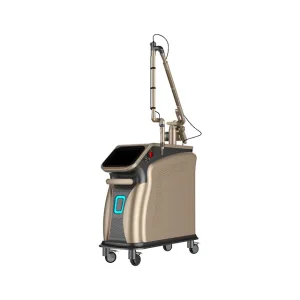
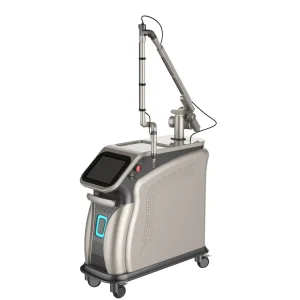
SANO Laser's flag-ship Q-Switched models utilize a high-precision Korean 7-joint optical articulated arm. Equipped with spring-balanced counterweights and dielectric mirrors delivering >98% reflectivity, this design minimizes energy loss, guarantees consistent spot positioning, and allows easy handling during long treatment sessions.
An internal optoelectronic beam splitter continuously monitors energy output before every pulse exits the optical aperture. If thermal variance or flashlamp degradation occurs, the smart CPU auto-adjusts input voltage to maintain selected fluence levels and protect skin tissue from unexpected energy spikes.
Unlike traditional Gaussian lasers that concentrate energy at the center causing pinpoint bleeding and scarring, SANO's flat-top beam shaper distributes optical fluence evenly across the entire spot area. This provides uniform tissue coagulation and lowers the risk of post-inflammatory hyperpigmentation (PIH).
As a leading OEM factory driving research and development in Beijing, Beijing SANO Laser is shaping the next decade of solid-state aesthetic lasers. Our technical roadmap focuses on advancing energy delivery, optical frequency conversion, and smart software integration.
While nanosecond Q-switched devices (3–6 ns) remain the clinical workhorse for general pigment clearance, transitioning to sub-nanosecond and picosecond pulse durations (300–500 ps) dramatically increases photomechanical stress. By shortening the pulse width below the acoustic relaxation time of small tattoo particles, mechanical pressure increases exponentially while thermal deposition drops toward zero. Our R&D team is scaling down resonator dimensions and implementing seed-laser amplification to make commercial picosecond systems reliable, cost-effective, and low-maintenance.
Current multi-wavelength treatments rely on dye handpiece attachments to generate 585nm (sky blue ink/vascular) and 650nm (green ink) output. SANO’s optical physics lab is developing solid-state Raman frequency shifter modules. These modules integrate directly into the main optical cavity to provide stable 585nm, 650nm, 755nm Alexandrite-equivalent, and 1064nm outputs from a single console, eliminating handpiece degradation and dye consumable costs.
Future iterations of SANO Nd:YAG platforms will feature integrated optical skin sensors within the handpiece tip. Before laser firing, the device measures localized melanin concentrations, epidermal hemoglobin levels, and skin hydration. The system's AI algorithm then automatically recommends optimal spot sizes, pulse delays, and fluence parameters tailored to the patient's Fitzpatrick skin type, minimizing operator error and maximizing treatment safety.
Beijing SANO Laser Development S&T Co., Ltd. operates a high-capacity manufacturing complex in Shunyi District, Beijing. By adopting Industry 4.0 manufacturing processes, automated optical alignment, and strict component sourcing, we offer global partners high product reliability and strong cost efficiency.
All optical cavities, Nd:YAG laser rods, electro-optic Pockels cells, and KTP frequency-doubling crystals are assembled in Class 10,000 dust-free cleanrooms. This prevents micro-particle contamination on optical coatings, avoiding laser damage, beam degradation, and premature cavity failure.
SANO directly sources core components from top global suppliers: UK Firstlight flashlamps, German optical lenses, and premium Nd:YAG crystal rods. Combined with in-house CNC chassis fabrication and custom PCB assembly, we maintain steady supply lead times and lower overall bill-of-materials (BOM) costs.
Every manufactured Q-Switched laser machine undergoes 72 hours of continuous energy output testing, high-temperature fluid circulation checks, and vibration resilience testing before packaging. Beam profile analytics are digitally documented for complete product traceability.
Different healthcare and aesthetic business models require tailored machinery configurations, operational workflows, and clinical capabilities. Below is how SANO configures its Q-Switched Nd:YAG solutions across key clinical sectors.
Core Needs: High energy stability, fine pulse controls, multi-wavelength capabilities, and medical certification (CE MDR / FDA compliance).
SANO Configuration Solution: EO Q-Switched Vertical Platform with 7-joint articulated arm, dual rod cavity setup, integrated spot size adjustments (1–10mm), and flat-top beam delivery. Perfect for recalcitrant melasma, Nevus of Ota, and post-inflammatory hyperpigmentation protocols.
Core Needs: High peak power output, rapid pulse repetition rates (up to 10Hz), and long-lasting optical flashlamps for continuous daily operation.
SANO Configuration Solution: High-energy Picosecond/Q-Switch hybrid system equipped with dual optical chambers, heavy-duty water-to-air cooling radiators, and optional 585nm/650nm dye handpieces to clear multi-color ink pigments quickly.
Core Needs: Versatile application range, intuitive touchscreen operation, low maintenance costs, and minimal operator risk.
SANO Configuration Solution: Multi-functional Q-Switched desktop/compact system with pre-set clinical treatment protocols, 1320nm Carbon Peel (Hollywood Facial) accessories, and fast skin rejuvenation settings.
Navigating medical equipment procurement requires full compliance with regional regulatory standards and reliable post-purchase technical support. SANO Laser provides complete global compliance frameworks and localized engineering assistance.
Our products are engineered and produced under strict international quality management standards. SANO platforms maintain ISO 13485 medical device quality system certification, Medical CE approval under European standards, and compliant technical dossiers for import registration across North America, Latin America, the Middle East, and Southeast Asia. We assist distributors with localized clearance documentation, test reports, and EMC/LVD electrical safety validation.
SANO provides comprehensive support services for international B2B partners:
When procuring high-value capital equipment like Q-Switched Nd:YAG laser systems, procurement teams must look beyond initial purchase price to evaluate long-term Total Cost of Ownership (TCO), maintenance expenses, consumable costs, and operational ROI.
Procuring directly from a China OEM factory like SANO reduces upfront capital expenditure by 40% to 60% compared to European or American brands, without sacrificing optical component quality. Lower initial equipment costs allow clinical facility owners to break even faster, often within 3 to 6 months of active patient treatments.
On the operational side, SANO Q-Switched platforms feature durable Xenon flashlamps rated for 1,000,000 to 3,000,000 shots. Highly efficient water pumps and deionized water filter cartridges keep annual consumable costs low.
For large equipment distributors, multi-location MedSpa franchises, and brand owners, SANO Laser provides customized OEM/ODM industrial manufacturing services:
Detailed answers to technical, clinical, and operational questions regarding Q-Switched Nd:YAG laser systems.
Q-Switched nanosecond lasers deliver light pulses in the 3 to 10 nanosecond range, shattering pigments using a combination of photoacoustic and photothermal energy. Picosecond lasers deliver pulses in the 300 to 800 picosecond range. The shorter pulse width of picosecond lasers produces a stronger photoacoustic effect with minimal thermal diffusion, breaking pigments into smaller particles for faster clearing of stubborn tattoos while lowering the risk of post-inflammatory hyperpigmentation (PIH).
Treating melasma requires low-fluence, multi-pass techniques known as "laser toning" using a 1064nm flat-top beam profile. By keeping fluence below the tissue destruction threshold (typically 1.2 – 2.0 J/cm² with a large 7–10mm spot size), the laser selectively damages melanosomes inside melanocytes without killing the cells or causing skin inflammation, avoiding rebound hyperpigmentation.
An Electro-Optic Q-Switch uses a high-voltage Pockels Cell to actively control pulse timing. This design produces much higher peak power, shorter pulse durations (3–6 ns vs 10–20 ns in passive systems), superior energy stability, and uniform flat-top beam delivery. Passive Q-switches use saturable absorber crystals that heat up over long treatment sessions, leading to fluctuating energy levels and longer pulse widths.
Routine maintenance includes replacing internal deionized (DI) water filters every 3 to 6 months, using pure distilled water for the cooling loop, and periodically cleaning handpiece output lenses with optical-grade alcohol wipes. SANO systems include built-in water flow and temperature monitoring sensors that notify operators when maintenance is due.
Tattoo removal requirements depend on ink composition, depth, age, location, and ink density. Professional dark black ink tattoos typically require 4 to 8 sessions spaced 6 to 8 weeks apart. Amateur tattoos clear in fewer sessions, while multi-color professional tattoos may require 8 to 12 sessions. Using high-peak-power active Q-switched lasers speeds up ink clearance and reduces total treatment counts.
Explore additional high-performance aesthetic and medical platforms manufactured by SANO Laser.