- +86 136 8127 5833
- [email protected]
- Shunyi, Beijing, China
Engineered for high-volume Toronto practices requiring rapid treatment speed, multi-wavelength versatility, and certified operating safety.
The Greater Toronto Area (GTA)—encompassing downtown Toronto, Mississauga, Markham, Vaughan, Brampton, and Richmond Hill—represents the most demographically diverse aesthetic medicine market in North America. With over 51% of residents identifying as visible minorities, medical spas and cosmetic dermatology clinics across Ontario face a unique clinical challenge: delivering safe, effective laser hair removal and skin rejuvenation across Fitzpatrick Skin Types I through VI within a single practice framework.
Traditional Intense Pulsed Light (IPL) devices, engineered in early decades primarily for Fitzpatrick I-III Caucasian skin, present elevated risks of epidermal burning, post-inflammatory hyperpigmentation (PIH), and inconsistent hair follicle clearance when applied to darker, melanin-rich skin phenotypes commonly treated in Toronto. Consequently, search intent among Toronto clinic owners, medical directors, and purchasing agents has shifted dramatically from generic "IPL suppliers" to "SHR (Super Hair Removal) machine factories" and "Narrow-Spectrum DPL (Dye Pulsed Light) manufacturers" capable of offering custom optical parameters, certified continuous-motion in-motion delivery, and factory-direct technical support.
Ontario's multicultural patient base requires broad spectrum pulse-stacking and active sapphire cooling (-5°C to -30°C) to safely treat melanin-dense dermal profiles without thermal epidermal damage.
High commercial rents in Yorkville, Financial District, and North York force clinics to maximize room throughput. 10Hz SHR motion technology cuts full-body treatment sessions from 90 to 25 minutes.
Equipment imported into Ontario must meet CSA SPE-1000 electrical safety standards and Health Canada medical device regulations to ensure insurance coverage and facility authorization.
From an industrial manufacturing perspective, evaluating an aesthetic machine factory requires examining component supply chains, optical filtration efficiency, and energy discharge consistency. Leading global manufacturers catering to the Toronto medical aesthetic market utilize modular engineering architecture to ensure long-term stability and zero operational downtime.
Unlike entry-level IPL devices that utilize low-capacity capacitors and standard quartz lamps, medical-grade SHR (Super Hair Removal) and DPL (Dye Pulsed Light) platforms built for high-volume commercial clinics incorporate key engineering components:
At the heart of our factory's OPT (Optimal Pulse Technology) handpieces are imported Heraeus (Germany) or Firstlite (UK) premium xenon lamps. Capable of outputting over 1,000,000 continuous shots without energy decay, these lamps maintain a stable spectral output, preventing unwanted infrared thermal spikes that cause skin blistering.
Thermal relaxation management is critical when delivering high-fluence pulses. Our manufacturing facilities integrate high-purity synthetic sapphire light guides coupled with Semiconductor Peltier cooling blocks and dual water-chiller circulation. This keeps the skin contact tip at a constant -5°C to 0°C even during non-stop 10-hour clinic shifts in Toronto summer heat.
SHR requires rapid, continuous energy discharge at 10 pulses per second (10Hz). Our power supply units feature industrial-grade Japanese Nippon Chemi-Con capacitor banks providing smooth square-wave pulse control (OPT technology). Energy is delivered uniformly across every single millisecond, eliminating painful peak energy spikes.
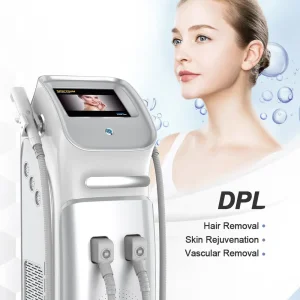
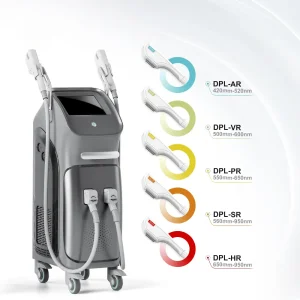
Standard IPL emits a diffuse spectrum from 400nm to 1200nm. DPL narrow-spectrum technology compresses energy into targeted excitation bands: 500-600nm for vascular/pigment therapy and 640-950nm for deep follicle destruction. This delivers laser-like absorption precision with pulsed light safety margins.
Purchasing directly from an aesthetic machine factory provides significant cost savings (eliminating 200%-400% middleman distributor markups). However, Toronto clinic directors must ensure imported medical lasers comply with local Canadian law and municipal health guidelines.
In Ontario, under the Ontario Electrical Safety Code, all electrical commercial equipment must bear an approved certification mark (such as CSA, cUL, or cETL) or pass an ESA SPE-1000 Field Evaluation before being energized. Our factory engineering team pre-configures system power supplies to meet 110V/220V 60Hz Canadian electrical standards, equipping machines with flame-retardant internal wiring, medical-grade power filters, and dedicated grounding points to pass SPE-1000 inspections seamlessly upon delivery in Toronto.
Laser and intense light devices intended for therapeutic or cosmetic medical treatments fall under Health Canada's Medical Devices Regulations. As a direct OEM factory supplier, we provide complete technical documentation, ISO 13485 quality system audit certificates, CB test reports, and IEC 60601-1 / IEC 60601-2-57 optical safety test data required for Medical Device License (MDL) registration and Medical Devices Active Licence Listing (MDALL) compliance in Canada.
To achieve optimal Information Gain, aesthetic equipment must be evaluated against real-world patient demographics and environmental factors specific to Southern Ontario.
Following summer outdoor activities along Lake Ontario and Muskoka, Toronto patients present high incidences of solar lentigines, freckles, and epidermal photoaging. Narrow-spectrum 500-600nm DPL handpieces selectively target epidermal melanin and hemoglobin without thermal diffusion into surrounding tissue, allowing full epidermal clearance in 2-3 sessions.
Treating Fitzpatrick IV-VI skin types requires avoiding high single-pulse fluences that induce keloids or PIH. Utilizing 640nm continuous-motion SHR (In-Motion 10Hz), the handpiece delivers multiple low-fluence pulses rapidly, gradually heating the hair follicle to 45°C while keeping the epidermis cool with active sapphire chilling. This makes hair removal 100% painless and completely safe for Afro-Caribbean and South Asian skin.
Severe winter temperatures and harsh wind chill in Ontario exacerbate facial erythema, telangiectasia, and rosacea flare-ups. Our factory's DPL Vascular filter (550-650nm) isolates oxyhemoglobin peak absorption wavelengths, coagulating micro-vessels rapidly without purpura or downtime, fitting busy corporate schedules in the Financial District.
Understanding the optical, energy, and operational differences between light-based modalities allows clinic directors to make informed capital equipment investments.
| Specification / Feature | Traditional Stamping IPL | Factory Continuous SHR (OPT) | Narrow-Spectrum DPL | 808nm Diode Laser |
|---|---|---|---|---|
| Target Spectrum | Broad 420 – 1200 nm | Broad 640 – 950 nm | Narrow 500-600nm / 640-950nm | Monochromatic 808nm / 755/808/1064nm |
| Pulse Delivery Mode | Single Stamping Pulse | In-Motion Continuous (1-10 Hz) | In-Motion & High-Peak Pulse | In-Motion & Fast Pulsed |
| Epidermal Safety (Fitzpatrick IV-VI) | High PIH / Burn Risk | Very Safe (Gradual Heating) | Extremely Safe (Targeted) | Gold Standard Safety |
| Patient Comfort Level | Painful ("Rubber Band Snap") | Virtually Painless | Minimal Warmth | Painless with Sapphire Cooling |
| Primary Indications | Fair Skin Hair & Light Pigment | Fast Full-Body Hair Reduction | Vascular, Pigment, Acne, Rejuvenation | Deep Hair Follicle Clearance |
| Treatment Speed (Full Back) | 45 - 60 Minutes | 12 - 15 Minutes | 15 - 20 Minutes | 10 - 15 Minutes |
| Handpiece Lifespan | 100,000 - 300,000 Shots | 1,000,000+ Shots (UK/German Lamp) | 1,000,000+ Shots | 20,000,000 - 40,000,000 Shots |
As an original R&D manufacturing plant, our laboratory is constantly pioneering next-generation optical and electromagnetic technologies to maintain competitive advantages for our global clinic partners.
Future factory builds incorporate real-time handpiece skin sensors that measure epidermal melanin index and hydration prior to energy emission. The system automatically adjusts joules, pulse width, and cooling intensity to eliminate operator error.
Combining narrow-spectrum DPL light energy with bi-polar radiofrequency (RF) allows deeper dermal penetration at lower optical fluences. This synergistically stimulates neocollagenesis while removing stubborn, fine vascularity.
To extend device operational life to over 10 years, our industrial engineering team is replacing mechanical diaphragm water pumps with silent, zero-friction mag-lev fluid pumps, ensuring ultra-stable cooling fluid flow.
Clear, unvarnished engineering answers to common purchasing and operational questions submitted by Ontario aesthetic practitioners.
Purchasing directly from an OEM factory eliminates intermediate distributor markups, saving 50% to 70% on capital acquisition costs. Additionally, factory procurement grants direct access to original engineering design schematics, customized software UI options, continuous spare parts inventory, and hardware modification capabilities that local third-party distributors cannot provide.
Traditional IPL applies high-energy single flashes on static skin, which creates sharp pain and carries high thermal risk for darker skin tones (Fitzpatrick IV-VI). SHR (Super Hair Removal) operates in continuous motion at 10Hz (10 flashes per second), delivering low individual pulse fluences rapidly. This gradually heats the dermis and hair follicle to target destruction temperatures (45°C) while active sapphire contact chilling protects the epidermis, delivering pain-free, burn-free results.
Standard IPL outputs light across a broad range from 400nm to 1200nm, meaning much of the light energy is absorbed by non-target tissue or converted into unproductive heat. DPL (Dye Pulsed Light) utilizes specialized optical filters to compress energy into precise 100nm bands (such as 500-600nm for vascular/pigment). This concentrated spectral energy matches the absorption peaks of hemoglobin and melanin with extreme efficiency, yielding faster clinical results in fewer sessions.
In Ontario, equipment must operate on standard Canadian voltage (110V 60Hz or 220V 60Hz) and meet electrical safety compliance through an approved certification mark or an Electrical Safety Authority (ESA) SPE-1000 field evaluation. Our factory builds every unit with medical-grade power supplies, proper grounding schemes, and complete safety test dossiers to ensure 100% compliance during Canadian facility inspections.
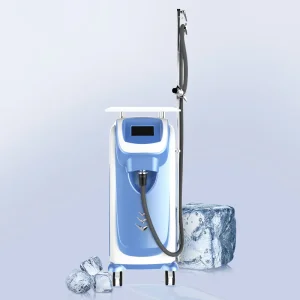
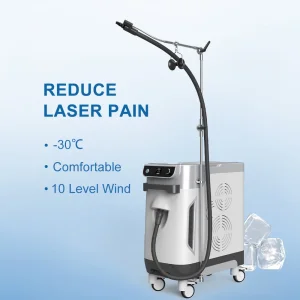
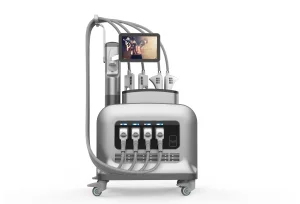
Explore our full suite of medical aesthetic hardware—from 980nm diode vascular lasers to Zimmer cold-air cooling systems and multi-mode body sculpting platforms.
Elevate your Toronto clinic's treatment capabilities, reduce capital equipment investment, and receive certified engineering support directly from our R&D manufacturing headquarters.
Send Inquiry Now