- +86 136 8127 5833
- [email protected]
- Shunyi, Beijing, China
Explore our top-tier OEM/ODM laser systems engineered for high clinical throughput, regulatory compliance, and rapid Return on Investment (ROI).
The global medical aesthetic landscape is undergoing a structural paradigm shift driven by demographic shifts, evolving body art trends, and significant advancements in solid-state laser physics. Unwanted tattoos, permanent makeup (PMU) regrets, and procedural cover-up preparations represent one of the fastest-growing revenue streams for dermatological clinics, medical spas, and specialized laser centers worldwide. However, for B2B clinic owners, aesthetic equipment distributors, and procurement directors, navigating the complex matrix of wholesale tattoo removal machine prices requires a rigorous understanding of hardware architecture, optoelectronic supply chains, and clinical efficacy benchmarks.
According to recent industry market intelligence, the global tattoo removal market is expanding at a Compound Annual Growth Rate (CAGR) exceeding 9.4%. Drivers include the miniaturization of high-peak-power lasers, transition from nanosecond Q-switched technology to ultra-short picosecond photomechanical breakdown, and an overwhelming surge in demand for safe pigment clearance across diverse Fitzpatrick skin types (I through VI). Understanding why direct factory wholesale prices range from $1,800 for entry-level Q-switched units to upwards of $25,000 for medical-grade active Q-switched Picosecond systems requires opening the chassis and analyzing the engineering within.
What accounts for the vast price variance between different laser suppliers? We evaluate the internal optoelectronic components that dictate clinical safety, power delivery, and machine longevity.
Passive Q-switched Nd:YAG systems utilize inexpensive crystal dye handles with wider pulse durations (6-10ns), suitable for basic cosmetic parlors ($1,500–$3,200). Active Electro-Optic (EO) Q-switched and true Picosecond engines utilize premium laser cavity rods (up to Φ8–10mm) and high-voltage Pockels cells to achieve sub-nanosecond pulse widths, commanding higher initial prices ($5,500–$22,000) but offering 4x faster pigment clearance.
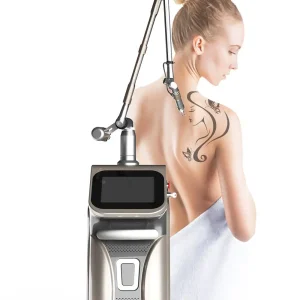
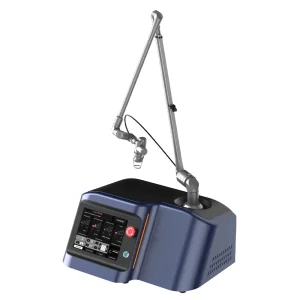
Entry-level machines rely on light guided through a direct optical fiber or simple handpiece, leading to energy loss and hot spots. Professional platforms feature Korean-imported 7-Joint Articulated Optical Arms with custom gold-coated mirrors. This guarantees flat-top energy distribution, minimal attenuation, and 360-degree ergonomic flexibility for multi-hour clinical sessions.
Maintaining consistent peak fluence across multi-hour clinic schedules requires a heavy-duty capacitors bank and a 2000W+ OPT power supply module. Combined with industrial-grade compressor refrigeration, dual water pumps, and oversized copper radiators, high-end thermal management prevents thermal throttling and extends flashlamp lifespan to over 10 million pulses.
| Machine Category | Optical Architecture | Pulse Duration | Target Applications | Est. Wholesale Price (FOB) |
|---|---|---|---|---|
| Portable Q-Switched Nd:YAG | Passive Handpiece (KTP/Nd:YAG) | 6ns – 10ns | Eyebrows, PMU, basic black ink | $1,500 – $3,200 |
| Vertical Active Q-Switched System | Electro-Optic (EO) Pockels Cell | 3ns – 5ns | Full tattoos, carbon peel, nevus of Ota | $4,500 – $8,000 |
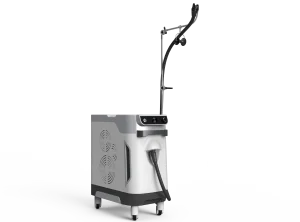
| Medical Picosecond Laser Platform | Dual-Rod Cavity + 7-Joint Arm | 300ps – 600ps | Multi-color ink, stubborn recalcitrant ink, epidermal melasma | $9,500 – $22,000 |
| Multimodality Workstation (Pico + IPL/RF) | Hybrid Modular Generators | Dual Pico & Nano Modes | Full-service MedSpas, comprehensive body reshaping & pigment | $12,000 – $28,000 |
Understanding the difference between photothermal and photoacoustic ink clearance is critical for evaluating machine specs. Legacy Q-switched lasers rely primarily on photothermal action, heating ink particles until thermal expansion causes micro-fracturing. However, if the pulse duration exceeds the thermal relaxation time of the ink chromophore, excess heat conducts into surrounding dermal tissue, elevating the risk of scarring, bladders, and post-inflammatory hyperpigmentation (PIH), particularly in Fitzpatrick IV–VI skin tones.
Modern advanced Picosecond systems operate in the photoacoustic regime. By delivering peak powers in gigawatts over picosecond pulse widths, the optical energy creates a localized acoustic shockwave. This stress wave shatters ink particles into micro-fine dust resembling fine sand rather than pebbles, allowing macrophages and the lymphatic system to clear the pigment rapidly in significantly fewer treatment sessions.
Deep dermal penetration with minimal epidermal melanin absorption. The primary workhorse for black, dark blue, dark brown inks, and safe treatment on darker skin types (Fitzpatrick IV-VI).
Highly absorbed by oxyhemoglobin and red/orange/warm pigment. Ideal for bright red, purple, tan, and orange tattoo inks, as well as superficial epidermal age spots and freckles.
Specialized solid-state dye handpieces target stubborn green, sky blue, and teal inks that are traditionally recalcitrant to standard 1064nm/532nm dual-wavelength systems.
Why direct sourcing from specialized manufacturers in China delivers superior technical specifications at an unbeatable price-to-performance ratio.
The manufacturing cluster situated in Beijing (specifically the Shunyi High-Tech District) represents the apex of Asia’s aesthetic laser engineering infrastructure. Over the past two decades, this ecosystem has integrated crystal growth laboratories (synthetic Nd:YAG and KTP crystals), precision optical lens coating facilities, high-voltage power supply foundries, and automated CNC chassis production lines.
Furthermore, robust modular manufacturing protocols allow for customized OEM branding, individualized GUI software design, localized electrical compliance (110V/220V switching), and tailored shell industrial design. Rigorous burn-in testing protocols—including 48-hour continuous shock firing, thermal stress cycling, and energy-intensity calibration via certified power meters—ensure that every platform leaves the factory floor meeting stringent clinical parameters.
High demand for cover-up preparation and rapid ink removal. Regulatory environments demand strict IEC 60825-1 laser safety standards, CE Medical (MDR) documentation, FDA 510(k) cleared parameters, and standardized foot-pedal dual interlocks.
Extremely high ambient operational temperatures require robust compressor chiller cooling systems to prevent laser cavity overheating. High demand for benign pigmented lesion removal and skin type IV-V safety protocols.
Rapid growth in permanent makeup (eyebrow, eyeliner, lip line) correction clinics alongside traditional body tattoo removal. Requires high-precision focus handpieces with adjustable spot sizes (1mm–10mm) for delicate facial treatments.
Direct answers to the most common engineering, pricing, and operational questions asked by aesthetic device importers and clinic directors.
Wholesale direct-factory prices typically range from $1,800–$3,500 USD for portable passive Q-switched Nd:YAG units; $4,500–$8,000 USD for vertical active Q-switched platforms; and $9,500–$22,000 USD for premium dual-rod Picosecond laser systems with 7-joint articulated optical arms.
A Picosecond laser delivers energy in picoseconds (trillionths of a second), creating a dominant photomechanical (photoacoustic) impact that shatters ink into micro-fine dust. Traditional Q-switched lasers operate in nanoseconds (billionths of a second), relying more on photothermal heat, which requires more treatment sessions and carries a higher risk of thermal damage to surrounding tissue.
Premium xenon flashlamps paired with high-grade UK-imported laser rods deliver between 5 million to 10 million effective shots. Flashlamp replacement kits are economical (typically $150–$400 USD) and can be easily serviced by trained technicians or local engineering staff.
A standard dual-wavelength system (1064nm and 532nm) effectively removes 80%+ of common dark and red inks across Fitzpatrick I–VI. For stubborn green, sky blue, and multi-colored tattoos, specialized dye handpieces (585nm / 650nm) or multi-wave picosecond platforms are recommended for complete clinical clearance.
Factory customization includes custom chassis color schemes, laser-etched brand logos, customized software boot screens, multilingual user interface options, preset clinical treatment parameters, and custom flight-case packaging for safe international freight.
Expand your practice offerings with our full portfolio of CE-compliant medical aesthetic platforms engineered for reliability and clinical success.