- +86 136 8127 5833
- [email protected]
- Shunyi, Beijing, China
Explore our engineering-validated medical aesthetic hardware available for factory-direct wholesale, custom OEM chassis branding, and global clinical distribution.
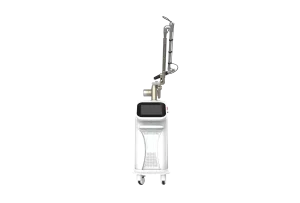
The global market for medical aesthetic pigment removal machines has undergone a paradigm shift from traditional photothermal destruction to ultra-short pulse photo-acoustic pulverization. Key market dynamics indicate a compound annual growth rate (CAGR) exceeding 12.4% through 2030, driven by escalating consumer demand for tattoo removal, melasma management, and age-spot correction across diverse skin phototypes.
Historically, early-generation aesthetic devices relied on nanosecond Q-switched lasers (pulse widths spanning 5 to 20 nanoseconds). While effective for basic epidermal lesions, nanosecond domain pulses primarily function via Selective Photothermolysis—converting optical energy into intense local heat. This heat frequently diffused into surrounding dermal tissue beyond the target chromophore's Thermal Relaxation Time (TRT), yielding post-inflammatory hyperpigmentation (PIH), localized blistering, and elevated scarring risks, particularly in Fitzpatrick IV–VI skin tones.
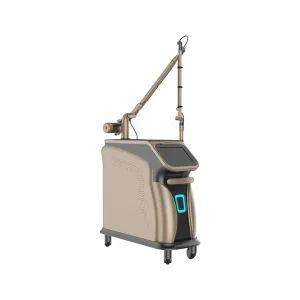
Modern clinical standards demand Picosecond-Domain Laser Engineering (pulse durations under 450–750 picoseconds). At picosecond pulse widths, the optical pulse duration is significantly shorter than the acoustic relaxation time of microscopic target melanosomes and ink pigment particles. Consequently, energy delivery induces an intense Photomechanical Stress Wave (Photo-Acoustic Effect) rather than purely thermal dissipation. Pigment aggregates are shattered into micro-dust particles, which are subsequently phagocytosed and cleared by the lymphatic system at double the velocity of nanosecond treatments, with near-zero collateral thermal trauma to surrounding keratinocytes.
Picosecond delivery (300–450 ps) converts photon energy into instantaneous acoustic pressure waves, fracturing target chromophores without thermal diffusion into adjacent tissue structures.
Integration of 1064nm (deep dermal melanin/dark ink), 532nm (epidermal freckles/red ink), and optional 755nm (Alexandrite/stubborn green & blue dyes) within a unified optical cavity.
Minimizing epidermal thermal retention enables safe treatment protocols for Fitzpatrick IV–VI skin types, vastly reducing post-treatment erythema, scarring, and rebound hyperpigmentation.
Purchasing directors, dermatological hospital groups, and regional aesthetic distributors follow stringent quantitative criteria when sourcing pigment removal machinery from original equipment manufacturers (OEMs).
Enterprise buyers calculate the true cost per million pulses. Industrial-grade laser cavities utilizing double-lamp, double-rod Nd:YAG architectures with imported xenon flashlamps offer operational lifespans exceeding 10,000,000 to 20,000,000 pulses, drastically dropping ongoing consumable overhead.
Global distributors mandate comprehensive certification standards including Medical CE (MDR 2017/745), US FDA 510(k) clearances, ISO 13485 medical quality management, and RoHS environmental compliance to ensure rapid customs clearing and legal clinical operation across Western markets.
Clinical efficacy hinges on optical beam homogeny. Enterprise buyers reject hot-spot-prone Gaussian beams in favor of articulated 7-joint Korean optical arms delivering uniform Flat-Top (Top-Hat) Beam Profiles, preventing epidermal micro-burning and localized hot spot necrosis.
Distributors establishing regional brand equity require modular UI localized in over 12 languages, modular chassis customization, custom shell colorways, and integrated remote diagnostic systems for instant field troubleshooting.
When evaluating China-based laser manufacturers, verifying the supply chain origins of core optical elements is paramount. Premier platforms utilize laser rods sourced from specialized crystalline laboratories, pulse power supplies engineered with high-frequency switching circuits, and gold-plated reflector cavities that maintain energy output stability within a tight ±3% tolerance across continuous 8-hour operational cycles.
China's aesthetic equipment manufacturing ecosystem has evolved into a global powerhouse, combining automated assembly lines, deep vertical integration, and rigorous ISO-certified quality assurance controls.
The concentration of precision optical engineering, CNC aluminum machining, power electronic manufacturing, and software development within China's key industrial clusters (such as Beijing, Shanghai, and Guangdong) provides unparalleled competitive advantages for international wholesale purchasers. Rather than relying on multi-tiered international component subcontracting, Tier-1 Chinese factories manage over 85% of structural and optical assembly in-house.
From sheet metal chassis stamping and injection molding to high-voltage capacitor testing and optical calibration, integrated manufacturing shortens lead times for wholesale bulk orders from months to 7–14 business days.
Optoelectronic handpieces and laser cavities are assembled inside Class 10,000 dust-free cleanrooms. Every optical component undergoes multi-point power meters checks, beam profiling, and 72-hour continuous thermal burn-in testing prior to crating.
By leveraging immense raw material procurement scale, Chinese manufacturers deliver OEM medical laser platforms at 30%–50% of European or Korean acquisition costs without sacrificing peak energy output or safety standards.
Understanding the hardware parameters separates commercial-grade clinical platforms from lower-tier salon equipment. Review the comparative specifications below.
| Performance Parameter | Advanced Picosecond Platform | Standard Q-Switched Nanosecond | Clinical Impact & Advantage |
|---|---|---|---|
| Pulse Duration | 300ps – 450ps | 5ns – 10ns | 75% higher photo-acoustic pressure; zero dermal thermal damage. |
| Primary Mechanism | Photomechanical / Photo-Acoustic Wave | Photothermal (Heat Accumulation) | Shatters pigment into fine micro-particles for faster clearance. |
| Peak Power Output | 1.33 Gigawatts (GW) to 2.0 GW | 0.1 GW to 0.2 GW | Higher peak energy breaks dark dermal inks and deep melasma. |
| Wavelength Options | 1064nm, 532nm, 755nm, 650nm, 585nm | 1064nm, 532nm, 1320nm (Carbon Doll) | Full-spectrum multi-color tattoo removal capabilities. |
| Beam Distribution | Flat-Top (Top-Hat) Lens Array | Gaussian (Central Hot Spot) | Prevents epidermal blistering, pinpoint bleeding, and scarring. |
| Target Clearance Speed | 3 – 5 Sessions Average | 8 – 12 Sessions Average | Increases clinic turnover rate and patient satisfaction scores. |
Demographic characteristics and regulatory landscapes vary dramatically across global markets. SANO customizes hardware presets and laser handpiece optics to address localized operational needs.
Primary Intent: Multi-color artistic tattoo removal, stubborn black ink clearance, and skin revitalizing fractionated treatments.
Key Demand: High peak power, 755nm Alexandrite handpiece modules, robust US FDA regulatory compliance dossiers, and quick-connect handpiece options.
Primary Intent: Treatment of Epidermal/Dermal Hyperpigmentation, Melasma, Nevus of Ota, and Hori's Nevus on Fitzpatrick Types III–V.
Key Demand: Low-fluence 1064nm Picosecond Toning modes, micro-lens arrays (MLA) for pore tightening, and extreme cooling to eliminate thermal PIH risks.
Primary Intent: Post-inflammatory hyperpigmentation remediation, sunspot correction, carbon laser skin peeling, and dark-skin tattoo clearance.
Key Demand: Continuous operation in ambient temperatures over 35°C requiring heavy-duty industrial water cooling radiators and dual TEC cooling pumps.
Browse additional medical aesthetic hardware engineered by SANO Laser for wholesale importers, clinic chains, and OEM distribution partners worldwide.



In-depth responses from our senior optoelectronic R&D team addressing critical inquiries from hospital buyers and OEM distributors.