- +86 136 8127 5833
- [email protected]
- Shunyi, Beijing, China
Direct-from-factory medical grade aesthetic devices for global distributors, medical spas, and aesthetic surgery centers.
The global medical aesthetic sector is experiencing an unprecedented surge in demand for non-invasive pigment clearance technologies. Market intelligence indicates that the global tattoo removal market, valued at approximately $450 million in 2023, is projected to expand at a compound annual growth rate (CAGR) exceeding 9.8% through 2032. This trajectory is propelled by evolving social dynamics, workplace dress code adaptations, the rise of "tattoo regret," and the booming market for cosmetic cover-ups.
Industrial clients—ranging from multi-location dermatology franchises and medical spas to specialized tattoo removal clinics—no longer view tattoo removal as a niche service. Instead, it serves as a high-margin foundational offering. However, the commercial success of any aesthetic facility depends heavily on purchasing the best laser tattoo removal machine capable of targeting diverse pigment hues without inducing epidermal scarring or post-inflammatory hyperpigmentation (PIH).
Achieving clinical superiority requires a deep understanding of selective photothermolysis. Traditional Q-switched nanosecond lasers deliver light pulse durations between 5 to 10 nanoseconds. While effective for basic black inks, nanosecond systems rely primarily on photothermal energy, heating ink particles until thermal expansion causes micro-fracturing. This extended thermal dissipation often damages adjacent dermal tissue, increasing patient discomfort and requiring longer recovery windows.
Delivers pulse durations in the nanosecond domain. Shatters larger ink aggregations via thermal expansion. Highly reliable for primary black, dark blue, and deep brown pigments. Cost-effective initial capital outlay.
Emits ultra-short pulses (350ps – 750ps). Induces a dominant photoacoustic shockwave that pulverizes ink into dust-like micro-particles. Allows faster lymphatic clearance with minimal thermal damage to surrounding tissue.
Combines 1064nm (dermal dark inks), 532nm (epidermal red/orange), 585nm (sky blue), and 650nm (green) wavelengths to provide full-spectrum pigment clearance across all Fitzpatrick skin types.
| Performance Parameter | Legacy Nanosecond Q-Switched | Industrial Grade Picosecond Platform | Clinical Advantage for Providers |
|---|---|---|---|
| Pulse Duration | 5 ns – 10 ns | 300 ps – 750 ps | 70% reduction in thermal diffusion risk |
| Primary Mechanism | Photothermal (Heat Expansion) | Photomechanical (Acoustic Shockwave) | Shatters ink into microscopic debris for faster phagocytosis |
| Peak Power Output | 0.2 – 0.5 Gigawatts | 1.0 – 2.5 Gigawatts | Clears recalcitrant and stubborn residual tattoo inks |
| Average Treatment Protocol | 8 – 12 Sessions | 4 – 6 Sessions | Doubles client throughput and clinical satisfaction |
| Epidermal Safety Margin | Moderate (Risk of hypopigmentation) | Superior (Protects dark skin Fitzpatrick IV-VI) | Expands patient eligibility demographics safely |
The global supply chain for medical aesthetic devices has undergone a structural transformation. Modern high-tech industrial parks in Beijing and Guangdong, China, have become world-class hubs for medical laser manufacturing. Leading OEM/ODM factories combine rigorous optical assembly standards with unparalleled supply chain economies of scale.
Top Chinese factories import core optical components—such as high-grade xenon flashlamps from the UK, premium laser cavity rods from the US, and 7-joint articulated arms from South Korea—combining them with robust local manufacturing efficiencies.
By eliminating excessive regional distribution markups, global purchasers can acquire medical-grade picosecond systems at 30% to 40% of the cost of equivalent Western brands, without sacrificing energy stability or beam quality.
Chinese factories excel at rapid customization. Overseas distributors can order specialized shell housing designs, customized GUI software languages, branded chassis colors, and pre-program tailored clinical protocol presets effortlessly.
State-of-the-art Chinese laser manufacturing plants adhere to rigorous international standards, including ISO 13485 medical quality management systems, CE certification, and RoHS electrical safety compliance. Every unit undergoes strict quality assurance:
A key purchasing factor for B2B buyers is how seamlessly a tattoo removal platform integrates into distinct operational environments. Modern aesthetic clinics require modular versatility to maximize equipment utilization rates.
Primary Needs: High-throughput reliability, multi-indication capabilities (tattoo removal, carbon peels, melasma treatment, nevus of Ota removal), and verifiable skin safety certifications.
Primary Needs: Targeted ink-fading capabilities for cover-ups. Requires simple user interface controls, durable handpieces, and affordable consumable replacement parts.
Primary Needs: Ultra-precise spot sizes (1mm to 3mm), safe energy fluences for facial procedures, and gentle removal of permanent makeup around delicate eye areas.
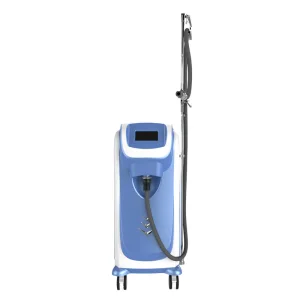
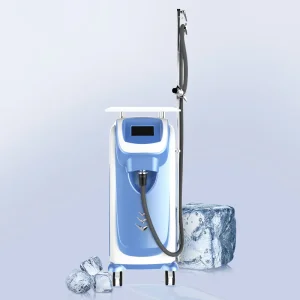
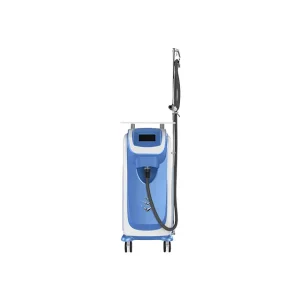
Modern clinical standards recommend pairing high-power laser tattoo removal systems with dedicated cold air skin cooling equipment (-30°C to -35°C). Continuous cold air delivery numbs the treatment area, minimizes epidermal edema, and improves patient comfort during intense laser treatments.
As optical research advances, the laser tattoo removal market is adopting several key technological innovations:
Next-generation devices utilize smart sensors to scan skin melanin density and ink depth automatically. The system then recommends the optimal energy fluence, spot size, and repetition rate, minimizing operator error.
PTP mode delivers sub-pulses spaced microseconds apart, generating strong photoacoustic shockwaves while reducing peak epidermal shock. This innovation makes treating dark Fitzpatrick skin types safer than ever.
Modern factories are transitioning from legacy freon compressors to high-efficiency, quiet semiconductor cooling modules, ensuring stable continuous operation while reducing energy consumption.
Expand your clinic's service offerings with our high-performance aesthetic and dermatological treatment platforms.