- +86 136 8127 5833
- [email protected]
- Shunyi, Beijing, China
Engineered for continuous medical-grade operation, clinical precision, and multi-platform compatibility.
Understanding the shift in B2B procurement towards dedicated forced-cold-air cryo technology in modern medical dermatology.
Key Takeaway for B2B Purchasing Officers & OEMs: Modern clinical protocols demand targeted thermal management. Integrating an advanced OEM skin air cooling machine lowers patient pain scores by up to 75%, reduces epidermal thermal injury risks to under 0.1%, and permits up to 30% higher laser fluence settings, directly optimizing clinical outcomes.
In the contemporary global medical aesthetics market, thermal management during energy-based device (EBD) procedures has evolved from a luxury comfort feature into a non-negotiable clinical safety standard. As energy levels across 808nm diode lasers, picosecond platforms, fractional CO2 systems, and intense pulsed light (IPL/DPL) units escalate to achieve permanent tissue clearance, the basal layer of the epidermis faces severe photothermal stress. Without efficient, continuous thermal dissipation, risks of thermal burns, post-inflammatory hyperpigmentation (PIH), blabbing, and patient dissatisfaction spike dramatically.
Enterprise buyers—ranging from multinational medical device distributors and hospital procurement syndicates to high-end chain dermatology centers—are shifting away from legacy cooling methods such as contact sapphire plates, cryogenic sprays, and static ice packs. Forced-cold-air cooling systems, capable of continuously generating sub-zero temperatures (ranging from -20°C down to -35°C) with variable airflow velocity, have established themselves as the gold standard in non-contact epidermal protection.
The operational logic behind enterprise procurement of skin air cooling devices is grounded in three commercial pillars:
By constantly clearing surface heat prior to, during, and after laser pulse delivery, forced air cooling prevents epidermal thermal accumulation while leaving deeper target chromophores (melanin, oxyhemoglobin, water) unaffected. This eliminates liability stemming from accidental burns, particularly on dark skin types (Fitzpatrick IV–VI).
Clinicians can safely boost energy fluence and compress pulse duration, achieving target endpoints in fewer treatment sessions. Higher efficacy directly correlates with improved patient retention and enhanced clinical reputation.
Unlike R134a cryogen spray canisters that impose recurring material and shipping costs, forced air chillers utilize room air, purifying and compressing it via mechanical refrigeration circuits. This converts a variable operating expense into a single fixed capital investment with near-zero marginal cost per treatment.
Deconstructing the refrigeration loops, heat exchange mechanics, and thermal relaxation parameters of professional air cooling systems.
To fully appreciate the superiority of industrial OEM skin air cooling machines, one must examine the governing thermodynamic equation of epidermal heat dissipation during laser irradiation:
Q_dissipation = h · A · (T_skin - T_air) + ε · σ · A · (T_skin^4 - T_ambient^4)
Where h represents the convective heat transfer coefficient, A is the illuminated skin surface area, T_skin is the transient epidermal temperature, and T_air is the temperature of the impinged cold airflow.
By lowering T_air to sub-zero regimes (-30°C to -35°C) and maximizing forced convection via high-pressure variable-speed compressors, the convective heat transfer coefficient (h) scales exponentially compared to passive room cooling or static contact plates. Contact sapphire cooling plates often suffer from localized thermal saturation—where the glass tip heats up after rapid consecutive pulses, losing its cooling effectiveness. Forced-air chillers bypass surface contact entirely, supplying an inexhaustible thermal sink.
| Subsystem Component | Engineering Specification | Operational Function & Clinical Impact |
|---|---|---|
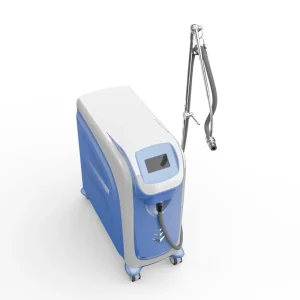
| Hermetic Rotary Compressor | Dual-stage high-efficiency R404a/R290 refrigerant loop | Rapidly pulls down temperature within 3–5 minutes of startup; sustains continuous -35°C air stream without thermal drift. |
| Ultra-Fine Filtration Deck | Multi-layer HEPA + moisture separation chamber | Strips ambient air of dust, particulate matter, and humidity before cooling, eliminating ice blockage inside the output hose. |
| Variable Airflow Fan Assembly | 1–6 Speed Settings (Up to 1500 L/min air volume) | Allows customized airflow matching: gentle cooling for delicate facial vascular work, maximal flow for high-speed body diode hair removal. |
| Articulated Support Arm & Hose | Thermal-insulated flexible silicone tube with 360° rotational bracket | Enables hands-free operator usage; clips directly onto laser handpieces for synchronized energy delivery and cold air blast. |
| Intelligent Defrost System | Auto-sensing reverse cycle defrost circuit | Prevents evaporator coils from freezing up during 12-hour continuous clinic operational shifts. |
Integrating cold air platforms across diverse aesthetic modalities to elevate safety and clinical outcomes.
Modern aesthetic clinics rarely rely on a single energy modality. A successful enterprise solution demands seamless integration across multiple treatment protocols. OEM skin air cooling machines act as the universal thermal stabilizer across five major technology stacks:
Challenge: High fluence (up to 120J/cm²) combined with high repetition rates (10Hz sliding mode) rapidly heats the epidermis, causing pain and risk of burns on Fitzpatrick Types IV–VI.
Air Cooling Solution: Pre-cooling the treatment zone numbs sensory nerve endings (nociceptors). Parallel cooling during laser emission dissipates residual epidermal heat, allowing safe treatment of dark skin with high power settings.
Challenge: Photo-acoustic shockwaves generated by sub-nanosecond pulses shatter ink particles but create immediate epidermal cavitation and intense stinging sensations.
Air Cooling Solution: Continuous cold air blast provides immediate topical cryo-anesthesia, preventing superficial blister formation and reducing immediate post-treatment edema.
Challenge: Micro-thermal ablation zones (MTZs) leave the skin highly inflamed, with prolonged warmth and erythema lingering for hours.
Air Cooling Solution: Post-treatment cooling rapidly brings tissue temperature back to baseline without direct physical contact, preserving sterile field conditions and speeding up patient recovery.
Challenge: Broad-spectrum light pulses heat both epidermal melanin and superficial capillaries, creating a narrow safety margin during telangiectasia treatments.
Air Cooling Solution: Precise targeted airflow selectively protects background skin tissue while hemoglobin absorbs the target wavelength, preventing purpura and scab formation.
Pioneering smart thermal sensing, AI-driven airflow modulation, and eco-friendly refrigeration standards.
As a senior OEM manufacturer, our R&D engineering laboratory continuously pushes the boundaries of skin cooling mechanics. The evolution of skin air cooling devices over the next decade is focused on four core innovation axes:
Integrating real-time thermal infrared camera arrays into the air nozzle. The machine dynamically adjusts fan speed and thermal output millimeter-by-millimeter based on live epidermal feedback, guaranteeing constant skin safety.
Designing custom acoustic damping chambers, magnetic levitation fans, and internal sound baffles to minimize operation noise, ensuring a serene ambiance in high-end medical spas.
Transitioning our global production lines to Propane (R290) natural refrigerants with a Global Warming Potential (GWP) near zero, meeting EU F-Gas regulations and US EPA SNAP standards.
Engineering universal quick-connect mounting kits that lock onto any major laser handpiece brand (Candela, Alma, Lumenis, Cynosure, Cynosure-Palomar), facilitating streamlined single-operator usage.
Inside our manufacturing hub: quality control protocols, custom design services, and high-volume scalability.
As a leading OEM factory for skin air cooling machines, our manufacturing facility operates under rigorous ISO 13485 medical device quality management frameworks. We understand that global brand partners require far more than off-the-shelf assembly—they require custom engineering, brand customization, and reliable warranty support.
We provide complete exterior casing design, custom injection molding, customized UI software layout (in 15+ languages), and private-label logo placement. Your brand identity is seamlessly reflected across every exterior panel and screen interface.
Every chiller unit leaving our assembly line undergoes a continuous 72-hour stress test inside temperature-controlled environmental chambers. Compressors, fans, and sensors are verified under 45°C ambient heat and 90% humidity stress conditions.
By standardizing component platforms across our laser and cooling lines, we maintain deep safety stock levels for compressors, PCBs, fan motors, and hoses—guaranteeing spare part dispatch within 24 hours of request.
Navigating global certification frameworks to ensure seamless import, distribution, and local clinic deployment.
Exporting medical aesthetic equipment globally requires strict adherence to regional electrical, safety, and medical directives. Our product architecture is built from the ground up to comply with major international regulatory bodies:
Fully compliant with EU Low Voltage Directive (LVD 2014/35/EU) and Electromagnetic Compatibility (EMC 2014/30/EU). Technical dossiers (TCF) are structured to support medical CE certification routes.
Systems incorporate flame-retardant ABS/metal chassis materials, UL-certified electrical power wiring, and dual-pole circuit breakers required for US/Canada commercial deployment.
Equipped with auto-switching transformer modules handling 110V (60Hz) for Americas/Japan and 220V–240V (50Hz) for Europe, Asia, and Middle East regions without external converters.
Expert technical answers for B2B buyers, distributors, and biomedical engineers.
Complete line of certified medical laser, cryolipolysis, and body sculpting systems.