- +86 136 8127 5833
- [email protected]
- Shunyi, Beijing, China
Direct Factory Sourcing Solutions & Medical-Grade Laser Machinery for Global Distributors and Clinics
Analyzing Market Dynamics, Technological Paradigm Shifts, and China's Emerging Dominance in Photomechanical Device Manufacturing
Early legacy tattoo removal relied heavily on nanosecond Q-Switched lasers utilizing purely photothermal dissolution. Modern Chinese OEM manufacturing focuses on picosecond ultra-short pulse durations (down to 375ps-450ps), shifting the clinical mechanism to pure photoacoustic fragmentation. This drastically minimizes thermal damage to surrounding tissue and accelerates macrophage-mediated clearance.
Leading Chinese factories have integrated premium imported components—such as Korean 7-joint articulated arms, German Xenon lamps, and high-purity Nd:YAG laser rods—into robust, industrial-grade chassis. This hybrid sourcing model bridges high-end optical engineering with scalable Chinese manufacturing efficiencies.
Modern tattoo machines manufactured in China undergo rigorous thermal modeling, beam profile homogenizing (Flat-Top beam profiles), and energy stability testing. Global clinical centers report significantly fewer treatment sessions required for recalcitrant dark, cyan, and multi-colored ink pigments.
When selecting a tattoo removal laser machine manufacturer from China, standard specifications like total energy (Joules) are insufficient without examining the pulse width (Picoseconds vs. Nanoseconds) and spatial beam profile. True professional-grade factories manufacture active Q-switched systems with flat-top beam output, eliminating central hot-spots that lead to epidermal blistering, scarring, and post-inflammatory hyperpigmentation (PIH).
An In-Depth Structural Breakdown of Upstream Optical Clusters, Modular Assembly, and Cost-to-Performance Superiority
China's aesthetic medical equipment manufacturing sector is supported by world-class industrial ecosystems in Beijing, Guangdong, and Shandong. These regions house specialized research facilities producing high-grade synthetic Nd:YAG crystals, KTP (Potassium Titanyl Phosphate) frequency-doubling crystals, and advanced power supply modules. This geographic concentration of optical engineering drastically reduces R&D cycles and component lead times.
Unlike Western suppliers that outsource major sub-assemblies to third parties, top Chinese factories maintain full control over CNC chassis machining, PCB circuit board design, software UI coding, and optical chamber assembly. This vertical integration allows global distributors to request customized housing colors, software language packs, logo integration, and proprietary preset parameters with low minimum order quantities (MOQs).
Leading ISO13485-certified factories enforce standardized quality gates. Laser power cavities undergo continuous 48-hour burn-in stress testing, energy output stability verification via digital power meters, and drop-testing for articulated arms. This ensures that machines shipped overseas maintain factory calibration and energy consistency throughout years of heavy clinical usage.
By leveraging mature localized supply chains for non-critical components while incorporating tier-1 imported optics (e.g., Heraeus lamps, South Korean light-guide arms), Chinese manufacturers provide medical aesthetic platforms at 30% to 50% lower capital expenditure (CAPEX) compared to European or American brands, without sacrificing clinical efficacy or operational longevity.
A Comprehensive Engineering Comparison of Modalities, Wavelength Mechanics, and Optical Beam Delivery
| Feature / Parameter | Passive Q-Switched Nd:YAG | Active Q-Switched Nd:YAG | Ultra-Picosecond Laser Platform |
|---|---|---|---|
| Pulse Width Range | 10 ns – 20 ns | 5 ns – 8 ns | 350 ps – 600 ps |
| Primary Removal Mechanism | Photothermal (Heat Expansion) | Photothermal + Light Photoacoustic | Pure Photoacoustic (Pressure Wave Shock) |
| Peak Power Capacity | Low to Moderate (10–50 MW) | High (100–200 MW) | Ultra-High (1.0–2.5 Gigawatts) |
| Target Ink Palette | Standard Black, Dark Blue | Black, Dark Blue, Red, Brown | Full Color Spectrum (Green, Cyan, Yellow, Red, Black) |
| Epidermal Recovery Time | 7 – 14 Days (Higher PIH Risk) | 5 – 7 Days (Moderate PIH Risk) | 24 – 48 Hours (Minimal Thermal Damage) |
| Average Sessions Required | 8 – 12 Treatments | 6 – 8 Treatments | 3 – 5 Treatments |
Professional Chinese tattoo machines incorporate multi-wavelength switching capabilities to target complex pigment spectra:
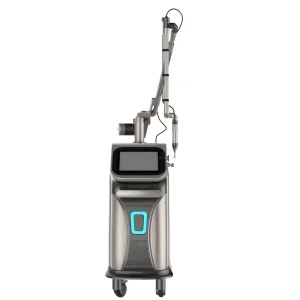
High-end factory configurations utilize imported 7-joint optical articulated balance arms. Unlike internal handpiece crystals which overheat rapidly, articulated arm systems house the heavy laser generator inside the main cabinet. This allows for larger crystal volumes, superior water-cooling capacity, perfect spot stability, and comfortable ergonomic handling during long clinical sessions.
To support high-frequency continuous operation (up to 10Hz-20Hz emission rates), modern Chinese factory designs combine TEC (Thermoelectric Cooling) semiconductor modules, high-capacity copper radiators, and German quiet-operation water pumps. Water temperature, flow rate, and pressure are actively monitored via smart microprocessors to prevent crystal degradation.
Key Purchasing Criteria for Medical Spa Chains, Equipment Distributors, and Aesthetic Enterprise Buying Groups
International distributors prioritize plug-and-play internal component design. Leading Chinese OEMs use modular wiring harnesses, quick-connect water fittings, and self-diagnostic power boards. If a field error occurs, local technicians can swiftly swap modules without returning the whole system to China.
Global suppliers demand extensive customization to build local brand equity. Chinese factories excel at customizing boot-screen animations, multi-lingual software interfaces (English, Spanish, French, German, Russian, Arabic), bespoke casing colors, and specialized GUI treatment guides customized for regional skin demographics.
Commercial viability hinges on consumable expenses. Top Chinese Nd:YAG and picosecond platforms guarantee millions of lamp flashes (typically 5 to 10 million shots per laser rod set) with low replacement costs, allowing clinic owners to maintain high gross margins per treatment session.
Ensuring Seamless Market Entry across North America, the European Union, Latin America, and the Middle East
For European buyers, acquiring aesthetic platforms certified under CE Medical standards (EU MDR 2017/745) is paramount. Top tier Chinese manufacturers prepare technical dossiers covering Risk Management (ISO 14971), Software Lifecycle Management (IEC 62304), and Clinical Evaluation Reports (CER), allowing importers to register devices with national health authorities smoothly.
Reputable factories in Beijing and Guangdong operate strict ISO 13485 certified quality management environments. Every step—from incoming optical inspection (IQC) to in-process assembly checks (IPQC) and final warehouse outbound inspection (OQC)—is documented to maintain batch-to-batch traceability.
High-power laser pulses generate significant electrical noise. Compliant manufacturers engineer machines equipped with advanced EMI filtering, grounded metal internal sub-chassis, and high-voltage isolation systems to meet international standards (IEC 60601-1 electrical safety and IEC 60601-1-2 EMC standards).
To overcome timezone differences, tier-1 Chinese manufacturers provide 24/7 technical helpdesks, dedicated video troubleshooting, localized spare parts warehousing in North America/Europe, and comprehensive door-to-door (DDP) air/sea freight logistics services.
Maximizing Versatility across Diverse Demographics, Ink Compositions, and Aesthetic Indications
Utilizing targeted 1064nm and 532nm wavelengths, operators can safely remove complex body art tattoos across Fitzpatrick Skin Types I–VI. Modern picosecond platforms break down stubborn iron-oxide and synthetic ink particles into microscopic fragments easily removed by the lymphatic system.
Micro-spot precision tips allow technicians to safely erase failed eyebrow microblading, lip liner, and eyeliner pigments. By adjusting fluence to sub-burn thresholds, operators protect natural eyebrow hair follicles while vaporizing unwanted pigment.
Equipped with a specialized 1064nm carbon-peel tip, the machine targets topically applied nano-carbon cream. The laser explosion gently exfoliates the stratum corneum, shrinks enlarged pores, controls sebum production, and stimulates dermal collagen remodeling.
Expert Engineering Answers to Common Questions Asked by International B2B Buyers and Clinic Directors
Explore Advanced OEM Medical Laser & Body Contouring Machines from Leading Manufacturing Operations