- +86 136 8127 5833
- [email protected]
- Shunyi, Beijing, China
Explore our certified manufacturing output engineered in compliance with international ISO 13485 and European CE safety directives.


A comprehensive analysis of multi-spectral optical technology, clinical intent decoding, and international compliance mandates for B2B importers and medical aesthetic chains.
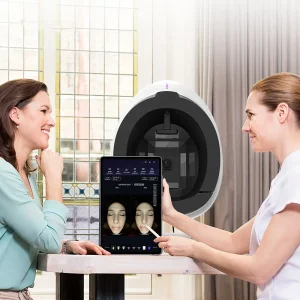
In the contemporary medical aesthetic and dermatological landscape, CE Certification Skin Scanning Machine Factories & Factory sourcing has shifted from basic optical photography toward deep-level multi-spectral quantitative diagnostics. As search quality guidelines prioritize E-E-A-T (Experience, Expertise, Authoritative, Trustworthiness) and real-worldInformation Gain, aesthetic practitioners and global distributors require total clarity regarding hardware specifications, optical sensors, algorithmic fidelity, and European regulatory compliance.
A certified skin analyzer is no longer merely a sales tool for aesthetic clinics; it serves as a high-precision diagnostic workstation capable of evaluating epidermal pore dilation, sebum distribution, porphyrin concentration, hyperpigmentation depth (melasmic vs. sun-induced), vascular telangiectasia, moisture retention, and dermal collagen breakdown. This technical white paper examines the engineering architecture, global factory standards, localized clinical deployments, and regulatory requirements defining modern skin scanning technology.
Understanding the shift toward unified multi-spectral diagnosis across medical dermatology, commercial medspas, and cosmetic R&D labs.
The global aesthetic diagnostic equipment market is projected to reach $4.2 Billion by 2030, driven by clinic demands for objective, data-backed treatment verification prior to laser, RF, or injectable therapies.
Over 75% of global skin scanning hardware is manufactured in specialized high-tech industrial hubs. Premier factories integrate optical lens assembly, chip-on-board (COB) LED surface mounting, and AI software design under one roof.
Medical aesthetics clinics using CE-marked multi-spectral skin analyzers report a 42% increase in patient conversion rates for high-value treatment packages (e.g., Fractional CO2, RF Microneedling, Pico Lasers).
Factory Insight: Authentic CE Certification (under Medical Device Regulation MDR 2017/745 or Low Voltage/EMC Directives) requires factories to demonstrate rigorous photobiological optical safety (IEC 62471) to ensure UV light bands do not cause actinic epidermal damage during diagnostic scanning cycles.
| Diagnostic Architecture Feature | Commercial Grade RGB/UV Analyzers | Medical-Grade CE Certified Industrial Factory Systems |
|---|---|---|
| Optical Sensor & Resolution | 12MP - 16MP Standard CMOS Sensors | 28.5MP - 36MP Industrial DSLR Optical Modules |
| Spectral Spectrum Bands | 3 Basic Modes (RGB, UV, Polarized) | 8 - 10 Advanced Spectra (RGB, Cross-Polarized, Parallel-Polarized, UV 365nm, Wood's Light, Red/Brown RBX, Spot Spectrum) |
| Illumination System | Standard Fluorescent / Basic LED Bulbs | High CRI (>95) Shadowless LED Ring Arrays with Shadow Reduction Lenses |
| Deep Dermal Analysis | Superficial Image Overlay | AI Deep-Learning Sub-Surface Epidermal & Micro-Vascular Mapping |
| Compliance Certification | Self-Declared CE (LVD only) | TÜV / SGS Audited CE Medical Device Compliance (ISO 13485 Manufacturing) |
| Software & Cloud Integration | Local Standalone Desktop App | HIPAA/GDPR Compliant Cloud Diagnostic Engine, Multi-Terminal Sync, Ageing Simulation |
Deconstructing the 10 core optical wavelengths utilized by premier CE-certified skin scanning machine factories.
Standard white-light illumination simulates natural daylight conditions (5500K color temperature). This spectrum captures macro-surface anomalies including surface wrinkles, coarse pore diameter, open comedones, gross skin texture roughness, and superficial scarring. High CRI (Color Rendering Index) LEDs ensure true-to-life pigment representation without color casting.
Polarization filters play a critical role in decoupling surface glint from sub-dermal reflectance. Parallel Polarization enhances specular reflections from the stratum corneum, highlighting subtle skin surface topography and micro-relief. Conversely, Cross-Polarized Light eliminates surface glare, allowing light to penetrate into the upper papillary dermis to expose hidden hyperpigmentation, dermal melasma, and micro-vascular erythema.
Ultraviolet illumination at a precise 365nm peak wavelength excites fluorophores in the skin. Porphyrins produced by Cutibacterium acnes fluoresce as distinct orange-red dots within pilosebaceous units. Wood's light mode detects sub-clinical dyschromia, epidermal moisture deficits, and subsurface sun damage invisible to the naked eye.
Red-Brown Complex (RBX) processing separates the unique absorption spectra of oxyhemoglobin and melanin. The RBX Red spectral band isolates vascular abnormalities such as rosacea, telangiectasia, spider veins, and acne-induced post-inflammatory erythema (PIE). The RBX Brown band isolates melanocytic concentrations, quantifying hyperpigmentation, freckles, and post-inflammatory hyperpigmentation (PIH).
Advanced factories incorporate infrared and specialized narrow-band imaging to measure the lipid-barrier function of the skin. By quantifying transepidermal water loss (TEWL) indicators through optical reflectance, the system alerts clinicians to compromised skin barrier function prior to aggressive chemical peels or ablative fractional laser treatments.
Clinical Advantage: Combining these 10 spectral modes allows practitioners to establish a baseline quantitative "Skin Age" score and accurately evaluate treatment efficacy over 30, 60, and 90-day intervals.
How specialized skin scanning machine factories build tailored hardware for distinct global market channels.
Medical-grade units equipped with quantitative lesion tracking, full patient history archives, and DICOM compatibility for hospital EMR integration.
Focuses on high-visual-impact 3D face rendering, automatic product recommendation engines, and patient-facing iPad/tablet interactive reports.
High-precision optical units calibrated for objective clinical trials, evaluating topical formulation efficacy, hydration lift, and spot reduction.
Customized cloud infrastructure enabling centralized multi-location management, standardized staff training, and master brand UI customization.
Navigating European Medical Device Regulations (MDR), EMC/LVD electrical directives, and ISO 13485 cleanroom audits.
When sourcing from a CE Certification Skin Scanning Machine Factory, international buyers must distinguish between low-level self-declaration safety certificates and accredited Notified Body compliance under the European Medical Device Regulation (MDR 2017/745). Authentic clinical skin analyzers require rigorous technical dossier documentation, risk management assessments (ISO 14971), and photobiological safety verifications.
How artificial intelligence, 3D volumetric photogrammetry, and hyperspectral imaging are reshaping skin analysis.
Transitioning from 2D flat spectral capture to 3D structured-light photogrammetry. Enables volumetric measurements of nasolabial folds, tear troughs, and facial volume loss for precise dermal filler planning.
Machine-learning models trained on millions of dermatological profiles to accurately predict structural skin aging 3 to 7 years in advance, simulating treatment outcomes with extreme accuracy.
Future factory roadmaps include narrow-band hyperspectral sensors capable of non-invasively measuring cellular ATP, lipid oxidation, and sub-dermal capillary oxygen saturation in real-time.
Authoritative technical answers from our engineering desk addressing hardware, certification, software, and sourcing logistics.
Explore additional high-demand clinical aesthetic and diagnostic systems available directly from our manufacturing facility.