An FDA Diode Laser is a medical laser device built around semiconductor technology. Its name can sound like a single, standardized category. It is not. The FDA evaluates specific devices, intended uses, and safety evidence, rather than approving every diode laser equally.
Laser physician and researcher Dr. Tina S. Alster has emphasized a practical principle: “A laser is a tool, not a treatment.” That distinction matters. A diode laser converts electrical energy into concentrated light through a semiconductor material. The selected wavelength targets a tissue chromophore, such as melanin, hemoglobin, or water. Absorbed light becomes heat. Controlled heat can reduce hair growth, influence vascular lesions, or support other dermatological procedures, depending on the device’s clearance and design.
The details are physical and visible. A handpiece may deliver a brief pulse, press against the skin, or use cooling before each flash. Power, pulse duration, spot size, and skin contact all affect the result. Small changes can alter comfort, tissue response, and risk. Treatment outcomes also depend on operator training and patient selection.
That is where the label can mislead. “FDA Diode Laser” does not guarantee identical performance across brands. It should prompt a closer review of the device’s FDA status, indications, wavelength, and clinical evidence. I may be simplifying the science here. Real skin does not behave like a laboratory chart. A qualified professional must still assess the person, the target tissue, and the safest treatment settings.
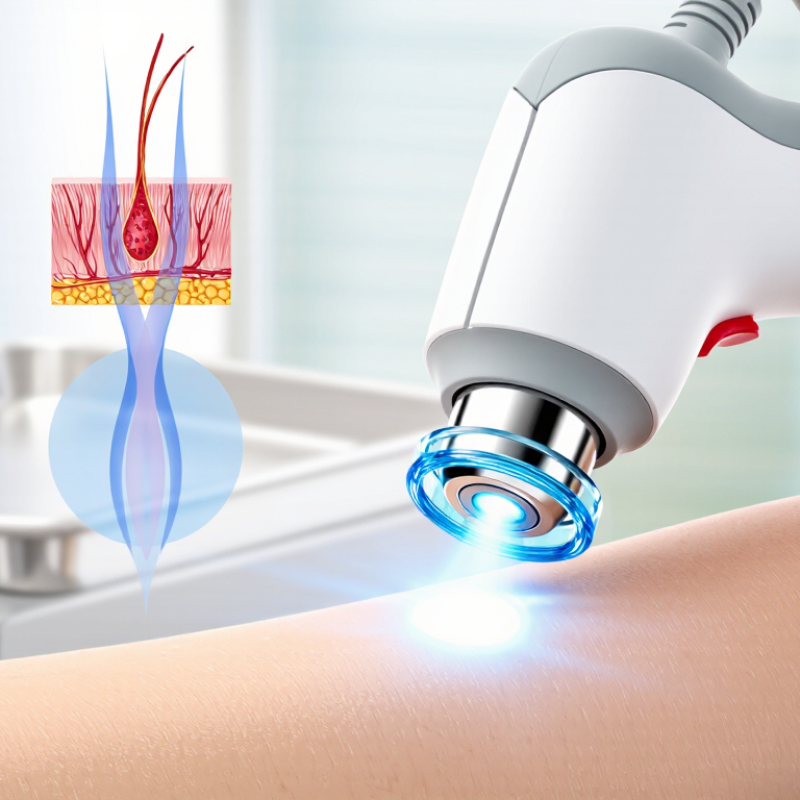
An FDA-cleared diode laser is a medical device reviewed by the U.S. Food and Drug Administration for specific uses. “Cleared” does not mean universally approved or risk-free. It usually means the manufacturer showed substantial equivalence to an existing legally marketed device. The clearance applies to defined settings, treatment areas, and intended purposes.
A diode laser uses a semiconductor to produce concentrated light at a selected wavelength. During treatment, the target absorbs this light and converts it into heat. For hair reduction, melanin in the hair shaft and follicle absorbs much of the energy. The handpiece may feel warm, while a cooling tip can reduce surface discomfort. Proper eye protection remains essential.
Real treatment outcomes depend on skin tone, hair color, hair thickness, hormonal factors, and device settings. A trained professional should review the device’s clearance, treatment instructions, contraindications, and maintenance records. Patch testing can reveal unexpected irritation before a larger session. It is also important to ask whether the planned use matches the cleared indication.
The term “FDA-cleared” can sound stronger than it is. It does not guarantee identical results for every person. In practice, careful assessment matters as much as the laser itself. Some users may need several sessions, and temporary redness can occur. Evidence and experience should guide expectations, not advertising language.
Representative diode-laser wavelengths used in medical and dermatologic applications
A diode laser uses semiconductor material to convert electrical energy into concentrated light at a specific wavelength. The wavelength influences how the light interacts with tissue: shorter wavelengths are commonly used for photobiomodulation, while wavelengths around 810–980 nm are widely used for deeper tissue heating, soft-tissue procedures, and other clinical applications. FDA clearance applies to a specific device and intended use through the 510(k) process; it does not mean that every diode laser wavelength is automatically FDA-cleared or FDA-approved.
An FDA-cleared diode laser uses semiconductor technology to create concentrated light. Inside the diode, electrical current crosses a specially designed junction. This movement releases photons, producing light at a selected wavelength. The wavelength determines how the light interacts with tissue, pigment, or another target.
The system then shapes and delivers that light through a fiber, lens, or handpiece. Small optical components help control the beam’s direction and spot size. Pulse duration, energy level, and repetition rate also affect treatment performance. Cooling may protect the surface and improve comfort. In practice, the process is precise, but results are never perfectly uniform. Skin tone, hair thickness, tissue condition, and operator technique can change the response. A clearance indicates a specific intended use, not universal safety for every person or procedure. That distinction is easy to overlook.
Tips: Confirm the device’s intended use and operating instructions. Ask whether the wavelength suits the target area. Protective eyewear should match the laser’s wavelength. Keep the handpiece steady and inspect the skin before treatment. Record settings and reactions carefully. Small changes matter. When results seem inconsistent, review technique, cooling, and calibration instead of increasing energy immediately. A qualified professional should assess contraindications and adjust settings responsibly.
What Is an FDA Diode Laser and How Does It Work?
Key Components and Operating Principles
An FDA diode laser is a medical device that uses a semiconductor chip to produce focused light. “FDA-cleared” usually describes a specific device and its intended use, not every diode laser. The laser wavelength determines how tissue absorbs the energy. For example, selected wavelengths may target melanin, hemoglobin, or water. This interaction creates controlled heat within a chosen treatment area.
Several components work together. The diode module generates light, while an electrical driver controls its output. Optical lenses shape and guide the beam through the handpiece. A cooling system helps protect the skin surface and supports patient comfort. Pulse duration, energy density, and repetition rate also affect the result. These settings should match the person’s skin type, treatment goal, and clinical assessment.
Tips: Check the device’s FDA clearance and intended use. Ask whether the operator has relevant training. Protective eyewear matters. Keep it on. In practice, settings are not always as neat as diagrams suggest. Skin response can vary during one session, so careful observation remains essential. A cooling fault, poor contact, or incorrect pulse selection may increase discomfort or reduce consistency. Operators should document settings and responses, then adjust cautiously when appropriate. Personal experience helps, but it should never replace device instructions, clinical judgment, or patient screening.
| Data Dimension | Typical or Applicable Information | Function and Operating Principle |
|---|---|---|
| Regulatory Meaning | “FDA diode laser” is an informal description, not a distinct technical laser category. | A medical device may be legally marketed in the United States through an applicable FDA pathway, such as 510(k) clearance, depending on its intended use and classification. |
| Laser Medium | A semiconductor diode made from compound semiconductor materials. | When forward current passes through the p-n junction, electrons and holes recombine and generate photons. Optical gain produces stimulated emission. |
| Common Wavelengths | Approximately 635–980 nm in many medical and aesthetic applications; other wavelengths are also possible. | Wavelength selection affects absorption by tissue chromophores, penetration depth, treatment target, visible appearance, and required protective controls. |
| Active Diode Junction | A thin active region between semiconductor layers with different electrical and optical properties. | The junction converts electrical energy into optical energy. Above the lasing threshold, stimulated emission dominates and a directed beam is produced. |
| Optical Resonator | Two partially reflective facets or an equivalent cavity structure formed around the active region. | The resonator provides optical feedback. One facet allows part of the amplified light to exit as the laser beam. |
| Electrical Driver | A regulated constant-current circuit with soft-start and protection functions. | It controls diode current and therefore influences optical output. Current limiting helps reduce damage from overcurrent and electrical transients. |
| Thermal Management | Heat sink, thermoelectric cooler, fan, or liquid-cooling system, depending on power and duty cycle. | Temperature control helps stabilize wavelength and output power while reducing thermal stress and maintaining diode service life. |
| Beam-Shaping Optics | Fast-axis and slow-axis collimation lenses, focusing lenses, apertures, or fiber-coupling optics. | Diode emission is naturally divergent and often asymmetric. Optical elements collimate, focus, homogenize, or deliver the beam to the treatment area. |
| Power Output | May range from milliwatt levels for low-power applications to multiple watts for some therapeutic systems. | Actual output depends on wavelength, diode configuration, pulse mode, treatment area, cooling, and the device’s intended use. The approved specification must be followed. |
| Operating Modes | Continuous-wave, gated, pulsed, or modulated operation. | Pulse duration, repetition rate, duty cycle, and delivered energy determine how heat is deposited and how the target responds. |
| Control and Monitoring | Microcontroller, temperature sensor, photodiode monitor, interlocks, and fault detection. | The control system regulates output, detects overheating or abnormal current, and can disable emission when a safety condition is not met. |
| Tissue Interaction | Absorption, scattering, reflection, and thermal diffusion influence the treatment effect. | The intended biological response depends on wavelength, irradiance, exposure time, spot size, tissue properties, and cooling conditions. |
| Safety Classification | Medical diode lasers are commonly capable of hazardous exposure and may fall into a high laser safety class. | Protective eyewear matched to the wavelength, beam enclosure or controlled access, warning labels, interlocks, and trained operation are essential. The exact class is device-specific. |
| Key Performance Parameters | Wavelength, output power, pulse duration, spot size, energy density, beam profile, and temperature stability. | These parameters determine beam delivery, dose control, treatment consistency, and the suitability of the device for its labeled indication. |
An FDA-cleared diode laser is a medical device cleared for specific uses, not a universal treatment license. Its semiconductor source emits a controlled wavelength, often near 755–1064 nanometers. Melanin or hemoglobin absorbs the light and converts it into heat. This process is called selective photothermolysis.
Hair removal remains a major cosmetic application. The 2023 ISAPS Global Survey reported more than two million laser hair-removal procedures worldwide. Diode systems target melanin in the hair shaft and follicle, while cooling protects the surrounding skin. Several sessions are normally required because hair grows in cycles. Results vary with skin tone, hair color, hormonal changes, and treatment settings. Gray hair responds poorly.
Laser devices also support certain vascular treatments, acne-related care, and skin-texture procedures. However, the FDA clearance must match the intended indication and body area. It does not automatically validate every claim made in advertising. The American Society for Dermatologic Surgery’s 2023 consumer survey showed continued interest in noninvasive cosmetic procedures, but interest is not the same as clinical suitability.
Small details matter. Eye protection must match the wavelength. A test spot can reveal excessive redness or delayed irritation. Darker skin may need conservative energy settings and longer cooling. Even experienced operators can misjudge a response. That is worth admitting. “More power” is not always better. Evidence, training, patient history, and documented follow-up should guide each session.
An FDA diode laser is usually an FDA-cleared medical device using a semiconductor light source. “FDA-cleared” matters: it indicates substantial equivalence, not guaranteed superiority. The diode emits a focused wavelength, often near 810 nanometers for hair reduction. Melanin absorbs the light, converts it into heat, and damages the follicle through selective photothermolysis. Skin cooling protects the surface. The physics sounds clean. Human skin is not.
Safety depends on wavelength, fluence, pulse duration, cooling, and operator training. FDA performance rules under 21 CFR 1040.10 and 1040.11 require controls, labeling, and protective features for applicable laser products. IEC 60825-1 also classifies laser hazards and supports risk-control procedures. Protective eyewear must match the laser wavelength, not simply look dark. Poor settings can cause burns, blistering, temporary pigment changes, or eye injury. Darker skin may need lower energy and longer pulses, yet overly cautious settings can produce weak results.
Benefits include targeted treatment, limited contact, and relatively short sessions. The American Academy of Dermatology notes that patients commonly need two to six treatments, while maintenance may remain necessary. Results vary with hair color, hormonal factors, skin tone, and treatment area. Blonde, gray, and red hair often respond poorly because they contain less suitable melanin. A 2023 systematic review in Lasers in Medical Science also emphasizes variable study methods and follow-up periods. Evidence is useful, but not perfect. That limitation deserves more attention.
It is a medical device using a semiconductor junction to create concentrated light. Electrical current releases photons. The selected wavelength shapes the interaction with tissue or pigment.
Wavelength influences which target absorbs energy, such as melanin, hemoglobin, or water. A poor match may reduce effectiveness or increase unwanted heating. Suitability needs assessment.
A diode module generates light, and an electrical driver controls output. Lenses guide the beam through a fiber or handpiece. Spot size and direction matter.
Pulse duration, energy density, and repetition rate affect treatment response. Cooling also influences comfort and surface protection. Small changes matter.
No. Clearance applies to a specific device and intended use. It does not guarantee suitability for every person, skin type, or procedure. That distinction is easy to miss.
Skin tone, hair thickness, tissue condition, cooling, contact, and technique can change the response. Results may differ across one treatment area. Perfect uniformity is unrealistic.
Confirm the intended use and operating instructions. A qualified professional should review contraindications, skin condition, target area, and settings. Protective eyewear must match the wavelength.
Review technique, cooling, contact, and calibration before increasing energy. Keep the handpiece steady. Record settings and skin reactions. More energy is not always the answer.
An FDA Diode Laser is a diode-based laser device that has received FDA clearance for specific medical or cosmetic uses, indicating that it meets established requirements for safety and intended performance. Unlike ordinary light sources, it generates a concentrated beam through semiconductor materials. Electrical energy stimulates the diode, producing light at a selected wavelength, which is then guided, focused, and delivered to the treatment area through an optical system or handpiece.
Key components typically include the semiconductor diode, power supply, cooling system, control panel, and delivery tip. By adjusting wavelength, energy level, pulse duration, and treatment mode, practitioners can target tissue with controlled precision. Common applications may include hair reduction, vascular treatments, skin rejuvenation, and certain therapeutic procedures. Benefits include focused energy, adjustable settings, and relatively efficient operation, while limitations may involve treatment discomfort, temporary skin reactions, varying results, and the need for trained professional supervision. Proper protective equipment, patient assessment, maintenance, and adherence to approved operating instructions are essential for safe use.