- +86 136 8127 5833
- [email protected]
- Shunyi, Beijing, China
Choosing the China best IPL SHR Hair Removal machine for wholesale requires more than comparing factory prices. Buyers must examine performance, safety controls, training support, and long-term service. The global aesthetic devices market continues to expand. Grand View Research identifies rising demand for non-invasive treatments as a major growth driver. Fortune Business Insights also reports increasing adoption of professional hair-removal equipment across clinics and beauty businesses.
The technology needs careful evaluation.
As consultant dermatologist Dr. Firas Al-Niaimi explains, “IPL is not a laser; it is a broad-spectrum light source.” This distinction matters when comparing IPL and SHR systems. A reliable machine should offer adjustable fluence, pulse width, skin-contact cooling, and clear operating protocols. Independent testing, traceable manufacturing records, and appropriate regional certifications strengthen buyer confidence. CE or FDA-related claims should always be verified through official documents, not sales images.
For wholesale buyers, practical testing is essential. Ask for treatment demonstrations on different skin tones. Check whether the handpiece remains cool after repeated pulses. Review warranty terms, replacement-part availability, and technician response times. Market reports can show strong commercial potential, but they cannot guarantee a supplier’s quality. That is where many purchasing plans become weak.
SHR branding is also inconsistent.
Some factories use the term for gradual, lower-energy delivery, while others apply it broadly. A thoughtful buyer should request measured specifications, not attractive labels. The best China supplier may not offer the lowest quotation. It should provide repeatable results, transparent documentation, and realistic training. Even experienced distributors can overlook after-sales support. That mistake becomes expensive after the first busy treatment season.
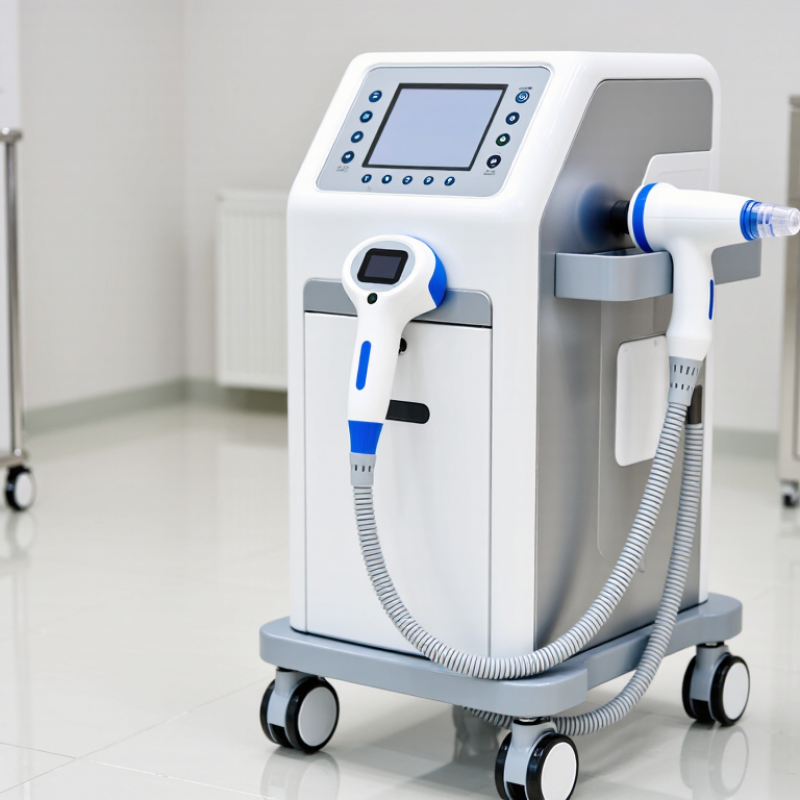
China Best IPL SHR Hair Removal Machine for Wholesale?
IPL vs. SHR: 650–1,200 nm Light and Selective Photothermolysis
IPL devices commonly use filtered broadband light, often covering approximately 650–1,200 nm. The exact range depends on the filter and machine design. Melanin absorbs selected wavelengths, converting light into controlled heat around the hair follicle. This is the practical basis of selective photothermolysis.
SHR usually delivers lower fluence with repeated pulses and gradual heating. Many operators find this approach more comfortable during larger treatment areas. However, comfort does not prove effectiveness. Skin tone, hair thickness, pulse duration, spot size, and cooling all influence results. Darker skin requires careful parameter selection, because surrounding melanin may also absorb light. It needs caution.
For wholesale buyers, specifications deserve more attention than attractive power ratings. Ask for measured wavelength data, fluence accuracy, pulse-width options, cooling performance, and service records. A test spot should be performed before broader treatment, with documented settings and skin response. Hair with strong pigment generally responds better than white, gray, or very light hair. That limitation matters.
A reliable supplier should provide operator training, maintenance guidance, safety documentation, and clear calibration procedures. Some advertised figures may describe theoretical output rather than usable treatment energy. That distinction is easy to miss. Review clinical evidence carefully, and avoid assuming that a higher number guarantees faster removal. Good purchasing decisions combine engineering details, operator experience, and realistic patient expectations.
| Comparison Dimension | IPL Hair Removal | SHR Hair Removal | Wholesale Evaluation Point |
|---|---|---|---|
| Light source | Broad-spectrum xenon flashlamp. Optical filters remove unwanted wavelengths and commonly deliver a hair-removal band around 640–1,200 nm. | Usually uses a filtered broad-spectrum flashlamp with a hair-removal band commonly around 650–950 nm or 650–1,200 nm, depending on the optical filter and handpiece. | Confirm the actual emission spectrum, filter markings, and calibration documentation rather than relying only on the “SHR” label. |
| Primary photobiological principle | Selective photothermolysis: melanin in the hair shaft and follicle absorbs light, converting it into heat that can reduce the follicle’s ability to produce hair. | Uses the same melanin-targeting principle, generally delivering lower energy per pulse with repeated pulses to gradually heat the follicle. | Performance depends on wavelength, fluence, pulse duration, cooling, hair pigment, skin type, and treatment technique. |
| Wavelength relevance | Longer wavelengths penetrate more deeply and are commonly selected for hair reduction; shorter wavelengths are more strongly absorbed by epidermal melanin. | A longer-wavelength filter can improve penetration, while controlled energy delivery and cooling help manage epidermal heating. | For darker skin, wavelength selection and conservative protocols are important because epidermal melanin also absorbs light. |
| Typical operating style | Stamping technique: the applicator is placed on the skin and a pulse or pulse sequence is delivered to each treatment area. | In-motion technique is common: the applicator is moved repeatedly over the area while delivering multiple lower-fluence pulses. | Check whether the device supports both stamping and in-motion modes, including independent control of fluence, pulse width, and repetition rate. |
| Representative fluence range | Approximately 10–50 J/cm² is seen across many professional IPL platforms, although the usable range varies substantially by device and treatment area. | Approximately 2–10 J/cm² per pulse is commonly associated with low-fluence SHR operation, but some systems provide wider ranges. | Request measured output data and verify whether the displayed fluence matches the delivered fluence at the applicator window. |
| Pulse and repetition behavior | Often uses a single pulse or a small number of sub-pulses with adjustable delay and pulse width. | Commonly uses repeated pulses at approximately 5–10 Hz during gliding treatment; the exact rate is device-dependent. | Higher repetition rates require effective thermal management, stable power delivery, and reliable safety interlocks. |
| Treatment sensation | A short snapping or warming sensation is possible, especially at higher fluence or on coarse, dark hair. | Often described as a gradual warming sensation because energy is distributed across repeated pulses, although discomfort can still occur. | Cooling quality, pulse control, operator training, and skin preparation strongly influence comfort. |
| Cooling system | May use sapphire contact cooling, water circulation, air cooling, or a combination of technologies. | Effective contact cooling is particularly important during repeated-pulse operation and may use sapphire, water, or thermoelectric cooling. | Evaluate cooling temperature stability, coolant flow monitoring, maintenance requirements, and handpiece ergonomics. |
| Best hair response | Generally responds best to coarse, dark hair because it contains more melanin to absorb optical energy. | Also performs best on pigmented hair; results are usually limited on white, gray, or very light-blond hair because of insufficient melanin. | Do not position either technology as reliably effective for hair without meaningful pigment. |
| Skin-type considerations | Often easier to use on lighter skin with dark hair. Higher skin pigmentation increases competing melanin absorption and may increase the risk of burns or pigment changes. | Lower-fluence, repeated-pulse protocols may improve comfort and flexibility, but darker skin still requires appropriate wavelength selection, cooling, patch testing, and conservative settings. | Look for documented protocols for different Fitzpatrick skin types and clear contraindication guidance. |
| Expected treatment pattern | Hair reduction generally requires multiple sessions because light primarily affects follicles in the active anagen growth phase. | Also requires multiple sessions for the same biological reason; treatment intervals should follow the hair-growth cycle and clinical protocol. | Avoid guaranteed permanent-hair-removal claims. Use evidence-based wording such as “long-term hair reduction.” |
| Main safety risks | Possible adverse effects include temporary redness, swelling, discomfort, blistering, burns, and temporary or prolonged pigment changes if settings are inappropriate. | The same categories of adverse effects are possible. Repeated passes or excessive cumulative heat can increase the risk of irritation and thermal injury. | Confirm eye protection, emergency stop, key switch, skin-contact sensing, temperature monitoring, and treatment-log functions. |
| Operational efficiency | High fluence can provide fast individual pulses, but stamping large areas may require more repositioning time. | In-motion treatment can cover large areas efficiently when repetition rate, spot size, and cooling are well coordinated. | Compare spot size, pulse interval, recharge time, handpiece weight, and actual treatment speed—not only headline power. |
| Key specifications to verify | Wavelength filter, spot size, fluence range, pulse width, sub-pulse delay, flashlamp life, cooling method, and electrical requirements. | Wavelength filter, in-motion mode, repetition rate, per-pulse fluence, cumulative heat control, cooling method, and electrical requirements. | Ask for a complete technical datasheet, output test report, user manual, warranty terms, spare-part availability, and conformity documentation required in the destination market. |
| Wholesale suitability | Suitable for buyers seeking a versatile platform for hair reduction and, where legally permitted and properly configured, selected photofacial applications. | Suitable for buyers prioritizing comfortable, efficient large-area hair-reduction workflows and operator-friendly in-motion treatment. | Select based on verified optical output, cooling performance, compliance, training support, serviceability, and total cost of ownership. |
Technical note: The specifications above are representative professional-device ranges, not universal standards. Actual performance varies by optical design, filter, handpiece, calibration, skin type, hair characteristics, and treatment protocol. IPL and SHR are light-based hair-reduction technologies; safe operation requires trained users, appropriate eye protection, patch testing, and compliance with applicable medical-device regulations.
Many IPL devices use filtered broadband light from about 650–1,200 nm. The exact range depends on the filter and machine design. The range matters.
Melanin absorbs selected wavelengths and changes light into controlled heat. This heat reaches the hair follicle through selective photothermolysis. Pigmented hair usually responds better.
SHR commonly uses lower fluence, repeated pulses, and gradual heating. Many operators find it more comfortable over large treatment areas. Comfort is not proof of effectiveness.
Skin tone, hair thickness, pulse duration, spot size, and cooling all influence results. Darker skin needs careful settings because surrounding melanin may absorb light. Parameter selection is critical.
Yes, perform a test spot before treating a larger area. Record the settings, skin response, cooling method, and treatment date. Small details matter.
Review measured wavelength data, fluence accuracy, pulse-width options, cooling performance, and service records. Do not assume a higher power rating guarantees faster hair reduction. I might overvalue headline power.
Request valid ISO 13485 documentation, relevant IEC 60601-1 test reports, and a Declaration of Conformity. Check the exact model, factory address, laboratory, testing date, and document scope. A logo proves little.
Check serial-number traceability, labeled fuses, protected wiring, emergency-stop function, and a readable treatment display. Ask how rejected components and customer complaints are recorded. Inspect the actual unit.
Inconsistent model names, expired certificates, narrow certificate scopes, and unclear calibration records deserve attention. Factory conditions can change after an audit. Documents may look complete.
Strongly pigmented hair generally responds better than white, gray, or very light hair. Set expectations before treatment and explain possible limitations clearly. Not every follicle responds equally.
Choosing the right Ipl Shr Hair Removal machine for wholesale requires more than comparing prices. IPL uses broad-spectrum light, while SHR delivers repeated, lower-energy pulses to gradually heat the hair follicle. A professional system typically operates within a 650–1,200 nm spectrum and relies on selective photothermolysis. Buyers should evaluate fluence, pulse width, cooling performance, spot size, and repetition rates from 1–10 Hz to ensure efficient and comfortable treatments.
Compatibility with Fitzpatrick skin types I–VI should be clearly documented, including recommended settings and safety guidance for different skin tones. When screening manufacturers in China, request verifiable ISO 13485 quality-management certification, IEC 60601-1 electrical safety evidence, and applicable CE documentation. Wholesale decisions should also consider MOQ, total equipment cost, warranty length, operator training, spare parts, software support, and after-sales service. A reliable supplier should provide transparent technical specifications, user documentation, and responsive assistance rather than focusing only on a low purchase price.